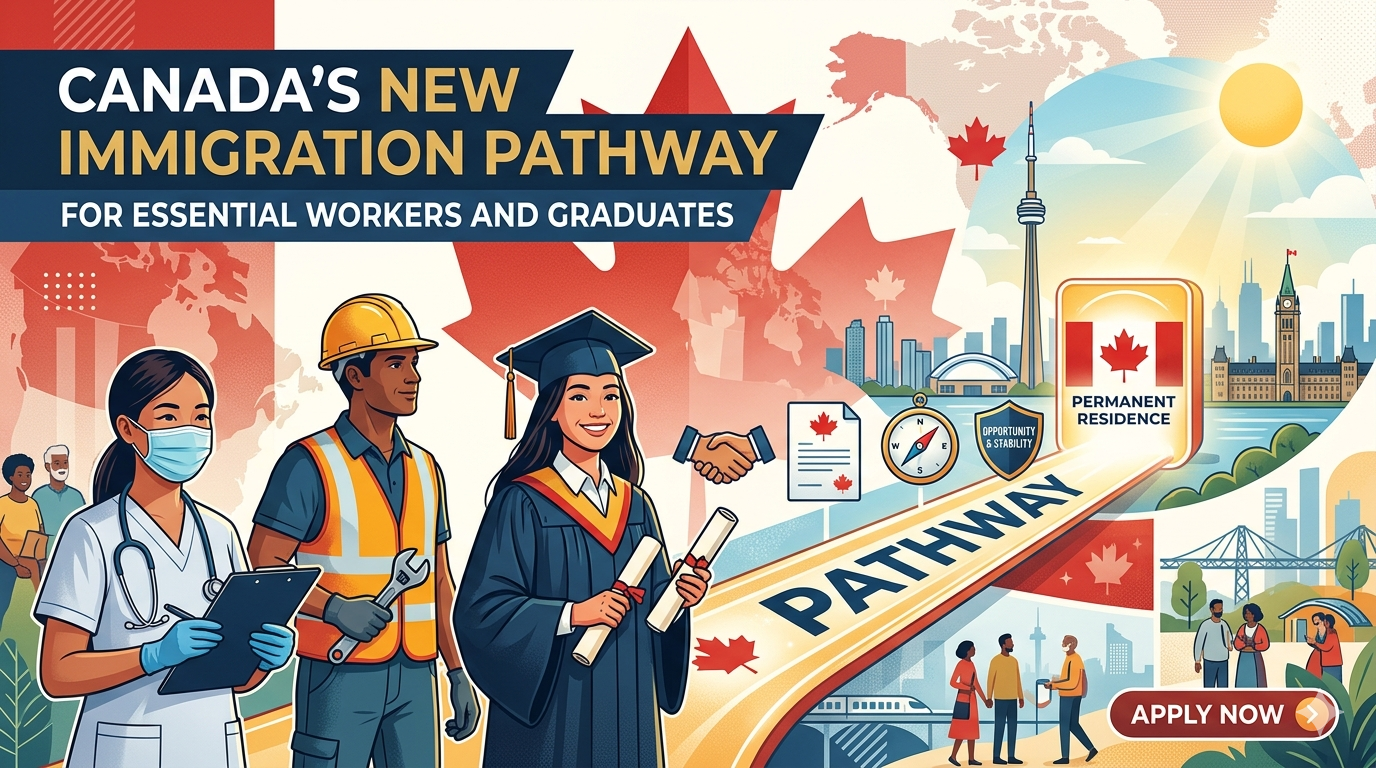
Canada’s New Immigration Pathway for Essential Workers and Graduates
In 2021, Canada introduced a groundbreaking immigration initiative that provided thousands of temporary residents with a new opportunity to become permanent residents. The program was announced by Immigration Minister Marco Mendicino and was designed to recognize the contributions of essential workers and international graduates during the COVID-19 pandemic.
For many foreign workers and graduates already living in Canada, the announcement offered a pathway to long-term stability, particularly for those whose work permits were nearing expiration.
A Special Open Work Permit for PR Applicants
As part of the initiative, Canada introduced a one-time open work permit for eligible applicants who had submitted permanent residence applications through the new immigration streams.
The program officially began accepting applications on July 26, 2021, allowing qualifying individuals to continue working legally in Canada while their permanent residence applications were being processed.
Who Was Eligible?
Applicants generally needed to meet several requirements, including:
- Having applied through one of the new permanent residence pathways
- Holding a valid work permit or work authorization at the time of their PR application
- Having a work permit that had expired or would expire within four months
- Maintaining legal status in Canada or being eligible to restore it
- Being physically present in Canada
- Meeting the language requirements of their chosen immigration stream
The Six Permanent Residence Pathways
Canada created six dedicated immigration streams aimed at helping temporary residents transition to permanent residency.
The pathways were designed for:
- Essential workers
- Recent international graduates
- French-speaking applicants
More than 90,000 application spaces were made available through these programs, demonstrating Canada’s commitment to retaining skilled workers and graduates already contributing to the country.
General Eligibility Criteria
To qualify, applicants typically needed to:
- Reside in Canada with valid status or be eligible to restore status
- Be physically present in Canada during both application and approval stages
- Intend to live outside Quebec
- Meet medical, security, and criminal admissibility requirements
Required Documentation
Applicants were required to submit various supporting documents through the immigration portal, including:
- Proof of legal status in Canada
- Employment records and work permits
- Language test results
- Passport identification pages
- Medical examination results
- Police clearance certificates
- Recent passport photographs
Additional Requirements for Essential Workers
Applicants under the essential worker stream needed evidence of qualifying Canadian work experience, such as:
- Employer reference letters
- Pay slips
- Work contracts
- Tax documents including T4 slips and Notices of Assessment
Additional Requirements for International Graduates
Graduates were required to provide:
- Official transcripts
- Graduation confirmation letters
- Proof of credential completion
Documentation needed to clearly indicate:
- Program completed
- Duration of study
- Date of graduation
- Educational institution attended
Documents not issued in English or French required certified translations.
Application Process
The process generally involved four stages:
1. Gather Supporting Documents
Applicants collected all required records and supporting evidence.
2. Complete the Online Application
Forms were submitted electronically through Canada’s immigration portal.
3. Pay the Required Fees
Applicants paid government processing fees, including biometrics fees where applicable.
4. Submit and Await Processing
After submission, applications entered processing and review by immigration authorities.
Frequently Asked Questions
Can Family Members Be Included?
Yes. Eligible applicants could include spouses, common-law partners, and dependent children in their applications.
Was Work Experience Required?
Yes. Applicants generally needed at least one year of eligible Canadian work experience within the previous three years.
Were Language Tests Mandatory?
Yes. Applicants were required to meet minimum language standards, typically equivalent to Canadian Language Benchmark (CLB) Level 4 in English or French.
What Educational Qualifications Were Accepted?
Eligible credentials generally included:
- Degrees
- Diplomas
- Certificates
- Attestation programs
Most programs needed to be at least eight months in duration and meet other eligibility requirements.
Why This Program Was Important
The COVID-19 pandemic highlighted the essential role that immigrants, temporary workers, and international graduates play in Canada’s economy and healthcare system. In response, Canada created these pathways to recognize their contributions and provide opportunities for long-term settlement.
The initiative helped thousands of temporary residents move closer to permanent residency while supporting Canada’s economic recovery and future workforce needs.
Final Thoughts
Canada’s 2021 essential worker and international graduate pathways represented one of the country’s most significant immigration initiatives during the pandemic era. By creating direct routes to permanent residency and offering open work permits to eligible applicants, Canada demonstrated its commitment to retaining talented individuals who were already contributing to communities and industries across the country.
For many applicants, these pathways became a life-changing opportunity to transform temporary status into a permanent future in Canada.