
In the exotic world of particle physics, neutrinos may be the most mysterious members. It rarely interacts with other matter, has little mass, and has no charge. These characteristics make it extremely difficult to study. Detecting them requires special facilities in deep caves, thick Antarctic ice, or the ocean floor.
One of the most advanced neutrino detectors is called KM3NeT, which stands for Cubic Kilometer Neutrino Telescope. Located on the ocean floor of the Mediterranean Sea, it detected the most energetic neutron ever observed in February 2023. It is called KM3-230213A and has an estimated energy of 220 PeV (220 x 1015 electron volt or 220 million electron volts). This is an incredible amount of energy, and ever since it was detected, physicists have been trying to pinpoint its source.
Neutrinos come from the high energy universe. This is the realm of catastrophic supernovae, gamma-ray bursts, kilonovas, and other unusually energetic phenomena. They are the only ones with the power to impart such high energies to particles. But tracing KM3-230213A back to either of these has been a scientific challenge.
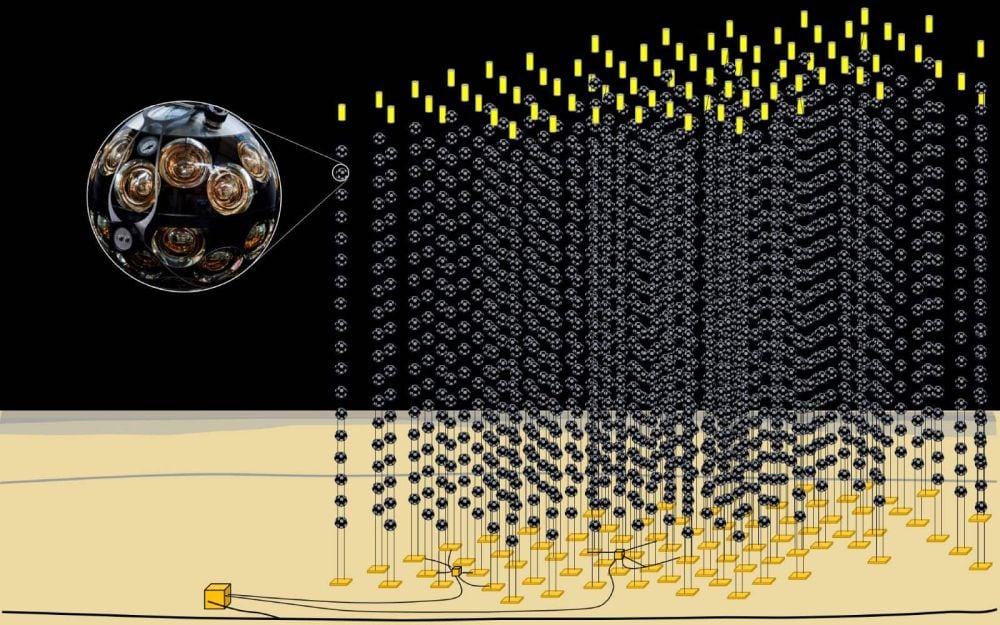
If neutrinos are difficult to detect, identifying their source can be even more difficult. Neutrino detectors don’t actually detect neutrinos themselves. Instead, it detects secondary particles, or Cerenkov radiation, that are produced when neutrinos interact infrequently with other matter. In the case of KM3-230213A, what was detected was muons.
Researchers associated with KM3NeT have published their findings in the journal Nature after an in-depth study of this high-energy phenomenon. The title of the research is “Observation of ultrahigh-energy cosmic neutrinos by KM3NeT.” KM3NeT Collaboration is listed as the author.
*This illustration is of the cubic kilometer neutrino telescope KM3NeT. It consists of a series of detectors fixed on the seabed of the Mediterranean Sea. Neutrinos rarely interact with other matter, so a large number of detectors are required. Image credit: KM3Net Collaboration*
“The detection of cosmic neutrinos with energies exceeding tera electron volts (TeV) provides a unique exploration into astrophysical phenomena,” the authors write. “Neutrinos, which are electrically neutral and interact only through weak interactions, are not deflected by magnetic fields and are unlikely to be absorbed by the interstellar medium. The neutrino’s orientation suggests that its cosmic origin may be in the farthest reaches of the universe.”
High-energy neutrinos have specific sources. These are produced when ultra-relativistic cosmic ray protons or atomic nuclei interact with matter or photons. According to the researchers, when scientists observe these neutrinos, it’s like seeing traces of the process itself.
“Neutrinos are one of the most mysterious elementary particles. Neutrinos carry no electric charge, have almost no mass, and have only minimal interactions with matter. Neutrinos are special cosmic messengers, providing us with unique information about the mechanisms involved in the most energetic phenomena and allowing us to explore the furthest reaches of the universe,” Rosa Coniglione explained in a press release. Coniglione was KM3NeT’s deputy press secretary at the time of the discovery.
Researchers were able to track where the high-energy neutrinos came from, but not exactly. Their research revealed four potential origins: galactic, local cosmic, temporal, and extragalactic origins.
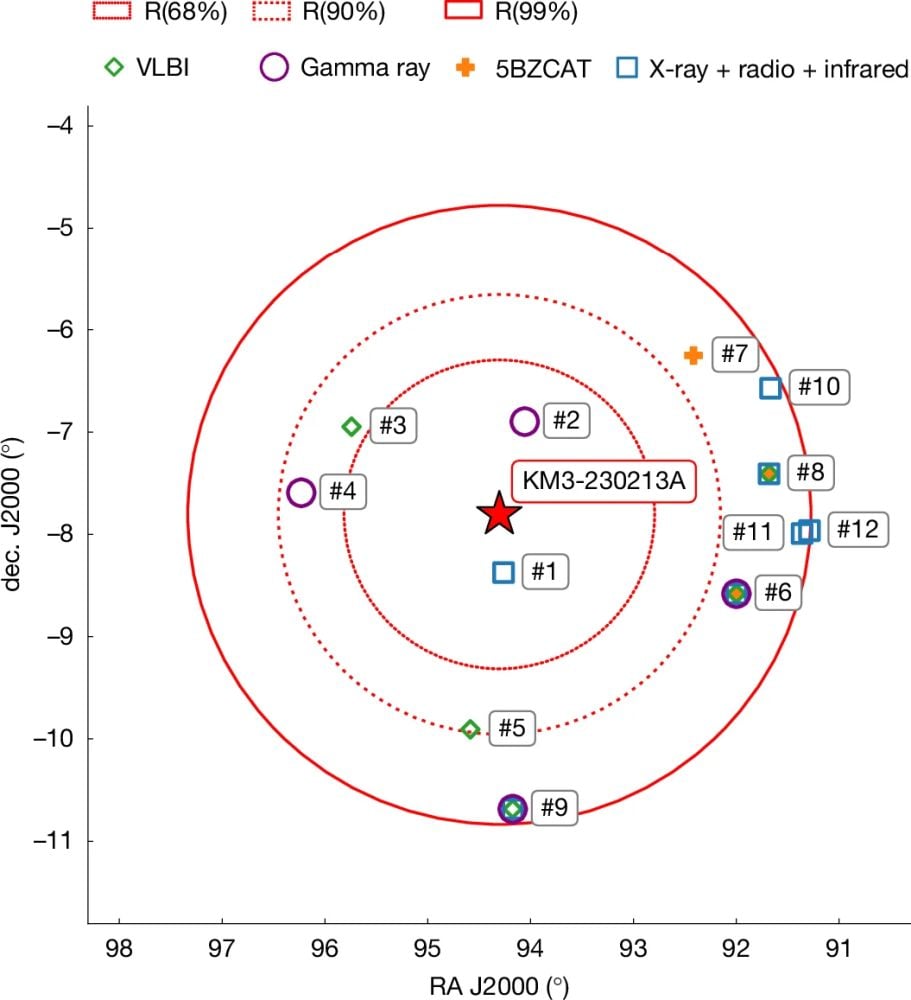 This diagram shows some of the potential sources of high-energy neutrinos. The red star indicates KM3-230213A, and the error regions within R(68%), R(90%), and R(99%) are indicated by dotted, dashed, and solid contour lines, respectively. The direction of the selected source candidate is displayed with a colored marker. The color and marker type indicate the criteria by which the source was selected. Sources are numbered according to their proximity to KM3-230213A. Image credit: KM3NeT Collaboration 2026. Nature.
The authors reminded in their paper that the energy of KM3-230213A was much higher than anything detected so far. There are several reasons why it is so energetic. It either originates from a different cosmic object than other low-energy neutrinos, or is an example of a cosmogenic neutrino. Cosmogenic neutrinos are currently largely a hypothesis, and no clear detection has yet been made. They are produced when ultra-high-energy cosmic rays, which are protons or heavier atomic nuclei traveling at near the speed of light, collide with photons from the cosmic microwave background radiation, a relic radiation from the Big Bang. This impact sets off a decay chain that triggers a cascading flood of other particles, including ultra-high-energy neutrinos like KM3-230213A.
Cosmogenic neutrinos are attractive for several reasons. They can point directly to its source, such as active galactic nuclei, gamma-ray bursts, or even galaxy mergers. Because they are produced throughout the history of the universe, they serve as probes of the early universe. And because they are much more energetic than anything that can be produced and studied in particle accelerators, studying them can reveal aspects of physics beyond the Standard Model. In short, they are a huge scientific success.
So, was KM3-230213A a cosmogenic neutrino? That’s within the energy range where physicists think cosmogenic neutrinos live. Is that enough?
The researchers say in their paper that the phenomenon could be cosmogenic neutrinos, an explanation that is “a viable alternative hypothesis…”
It all comes down to the extraordinarily high energy of neutrinos. “This suggests that the neutrinos may have originated in a different cosmic accelerator than low-energy neutrinos, or that this may be the first detection of cosmogenic neutrinos resulting from the interaction of ultra-high energy cosmic rays with cosmic background photons,” the researchers wrote.
Therefore, no clear conclusion can be drawn at this time.
Understanding these high-energy neutrinos will depend on future neutrino observatories and upgrades to current neutrino observatories. KM3NeT is extended to incorporate more detectors. This not only allows us to detect more neutrinos more effectively, but also allows us to more accurately identify their sources in the universe.
#energetic #neutrinos #detected #primitive