
The universe appears to be mostly empty space. Once you remove the stars, planets, dust, and gas, there is nothing left.
Physics tells a strange story. A vacuum isn’t really empty. It is full of restless energy and momentary quantum fluctuations. These are short disturbances that can generate pairs of virtual particles before disappearing again. These particles cannot be observed directly. However, their effects can shape material behavior in measurable ways.
Now, physicists working at the U.S. Department of Energy’s Brookhaven National Laboratory and Stony Brook University have discovered new evidence. Some of these hidden vacuum fluctuations can leave direct imprints on particles that can be detected. Their work points to a link between short-lived virtual quark-antiquark pairs in the vacuum and real particles produced in collisions of high-energy protons. The discovery provides a new way to study one of the biggest unsolved problems in physics. Specifically, the question is how quarks bind to matter.
“The vacuum is now understood to have a rich and complex structure, characterized by a fluctuating energy field and a condensation of virtual quark-antiquark pairs,” said physicist Zhoudunming Tu. “High-energy proton-proton collisions can liberate virtual quark-antiquark pairs from the vacuum, which can then form hadrons.”
Vacuum cleaner that doesn’t get quiet
The research focuses on quarks, the particles that make up hadrons such as protons and neutrons. Under normal conditions, quarks cannot exist alone. The strong forces trap them inside the composite particles, a phenomenon known as confinement.
That seems resolved, but the details remain unclear. Physicists know that while quarks are light, protons and neutrons are much heavier than the simple sum of the quarks’ masses. Light quarks have masses of only a few MeV. In contrast, protons and neutrons weigh about 1 GeV. That means that most of the mass in normal matter must come not only from the quarks themselves, but also from something else, the dynamics inside hadrons.
Spin adds more mystery. Experiments showed that quarks account for only about 35 percent of a proton’s total spin, much lower than the old quark model once suggested. Researchers are still trying to understand how confinement helps create both mass and spin within the particles that make up the visible universe.
what happens when protons collide
Tu and his colleagues approached the mystery by looking at what happens when protons, rather than stable matter, collide at extreme velocities. In the Relativistic Heavy Ion Collider (RHIC), protons were accelerated to 99.996 percent of the speed of light. These collisions disturbed the vacuum and released enough energy to turn the virtual quark-antiquark pair into a real particle.
The research team focused on strange quarks and strange antiquarks. According to the theory behind the experiment, these pairs should emerge from the vacuum with their spins parallel and aligned. If that spin pattern survived the messy transition from free quark to bound particle, it could serve as evidence. It means that the particles originate from vacuum condensate.
Intense transition after a spin
This transition is called hadronization. Once released, strange quarks cannot remain isolated for long. They quickly combine with other quarks to form hadrons. In this study, some of them became lambda hyperon and anti-lambda hyperon. These are short-lived neutral particles that contain strange quarks or strange antiquarks, respectively.
Lambda Hyperon decays in about 10 billionths of a second. But this is long enough for RHIC’s STAR detector to capture any particles it leaves behind. These decay products make Hyperon particularly useful. By tracking the direction of the daughter particles, researchers can reconstruct the hyperon’s spin. And because the strange quark retains the spin of the lambda hyperon in the non-relativistic SU(6) quark model, the measurements also preserve information about the original strange quark.
This gave the team a way to ask very specific questions. If strange quarks and strange antiquarks start out as bonded pairs in vacuum, will their spin correlation remain visible after hadronization?
At least for some pairs, the answer was yes.
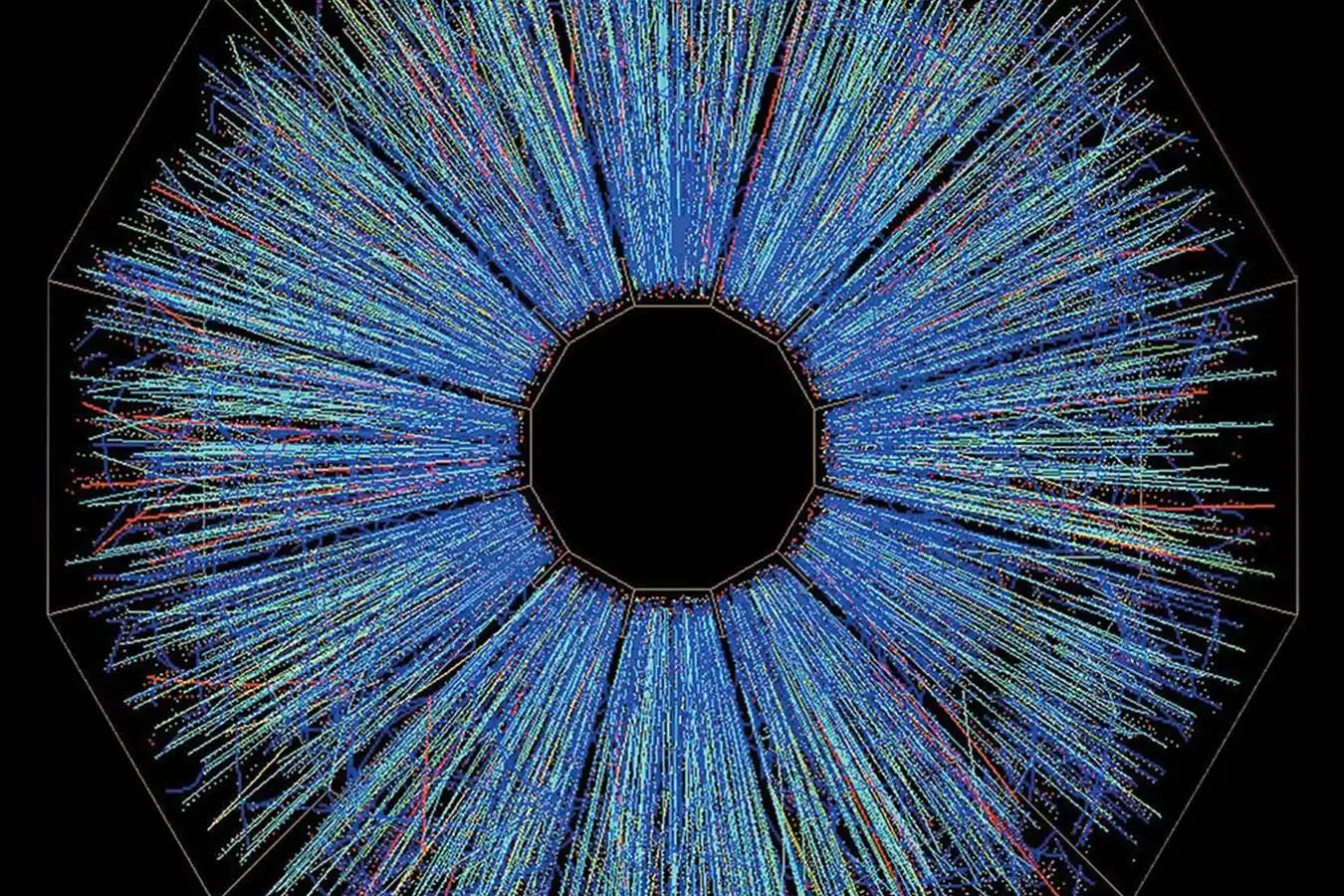
Proton-proton collision event
The researchers measured several combinations of hyperon pairs using approximately 600 million proton-proton collision events collected by STAR in 2012. They found that the short-range lambda and anti-lambda pair exhibited a positive spin correlation of 0.388, with a standard deviation significance of 4.4 relative to zero. In contrast, short-range lambda-lambda and anti-lambda-anti-lambda pairs showed spin correlations consistent with zero, as did all long-range pairs.
That distinction was important. The short-range lambda and anti-lambda pairs behaved as the vacuum-based images predicted. Their spins appeared to align in a manner consistent with a strange quark and strange antiquark arising from the same spin-correlated virtual pair.
The researchers also compared their results to measurements involving kaon pairs and simulations using the PYTHIA 8.3 Monte Carlo model. These baseline cases did not show spin correlation as expected.
A new handle on confinement
The researchers argue that the observed signal is strong evidence for vacuum quark pairs originating from chiral condensates, a feature of the QCD vacuum coupled with spontaneous chiral symmetry breaking. In this picture, the vacuum itself contains a condensate of virtual quark-antiquark pairs, including a strange pair. Furthermore, high-energy collisions can excite that vacuum enough to transform some of it into actual, measurable particles.
The results also provide scientists with a new way to explore nonperturbative QCD, an area where the usual simplification techniques break down. This is the difficult part of strong power. This is the part related to confinement and the emergence of hadronic structures.
The research team found that the spin correlation was strongest when the angles and velocities of the lambda and anti-lambda pairs were close. As the separation between particles increased, the spin correlation weakened and became consistent with zero. The researchers suggest that this loss may reflect decoherence caused by interactions or the involvement of multiple initial quark pairs during hadronization.
Within uncertainties, the short-range results were consistent with a model in which the original strange quark pair was perfectly spin-aligned. Another model, known as the Burkardt-Jaffe model, predicted smaller polarization, but the data was unpopular.
“[We found a link between] virtual spin-correlated quark pair from [vacuum] “Our findings provide a new experimental model to explore the dynamics and interactions of quark confinement and entanglement,” Tu said.
Practical implications of the research
This study does not solve incarceration. However, it provides a new experimental route to one of the most difficult problems in particle physics.
By tracing spin correlations from pairs of vacuum quarks to hadrons in their final state, this study could help researchers understand how hadron mass and spin emerge from quark confinement. It may also provide a more direct probe of the QCD vacuum and quark condensates. Both are central to understanding strong forces.
This method could be useful for future studies such as quantum decoherence, orbital angular momentum, hyperon spin structure, and chiral symmetry recovery in extreme forms of matter. It could also guide lattice QCD calculations and future experiments aimed at exploring how the building blocks of materials acquire their most fundamental properties.
The research results are available online in the journal Nature.
Related articles
#time #history #scientists #create #particles #empty #space