
Gravity is so strange that cosmologists are essentially forced to agree on one of two equally radical conclusions: either dark matter exists or the fundamental rules of gravity require major modifications. To settle the debate, scientists embarked on the largest-ever study of gravity and discovered that old physics wisdom is powerful when it comes to the most puzzling observations.
In a study published this week in Physical Review Letters, an international team of astronomers tested observations of the universe against Albert Einstein’s general theory of relativity, which was built on Isaac Newton’s fundamental laws of gravity. Today, general relativity, which defines gravity as a distortion of space-time, is one of the most successful ideas in the history of science. What’s “new” about this study is that it shows conclusively that even the largest and most distant structures in the universe obey laws of gravity similar to those we experience every day.
This puts a damper on alternative theories that seek to modify the fundamental rules of gravity to account for observational discrepancies in cosmology. So the basic rules are correct. It’s just that there’s something else we don’t see. Many scientists say that this “something” is dark matter.
“Gravity remains one of the most fascinating areas of research because there are so many unanswered questions,” Patricio Gallardo, one of the study authors and an astrophysicist at the University of Pennsylvania, said in a statement. “It’s a naturally attractive field.”
something beyond
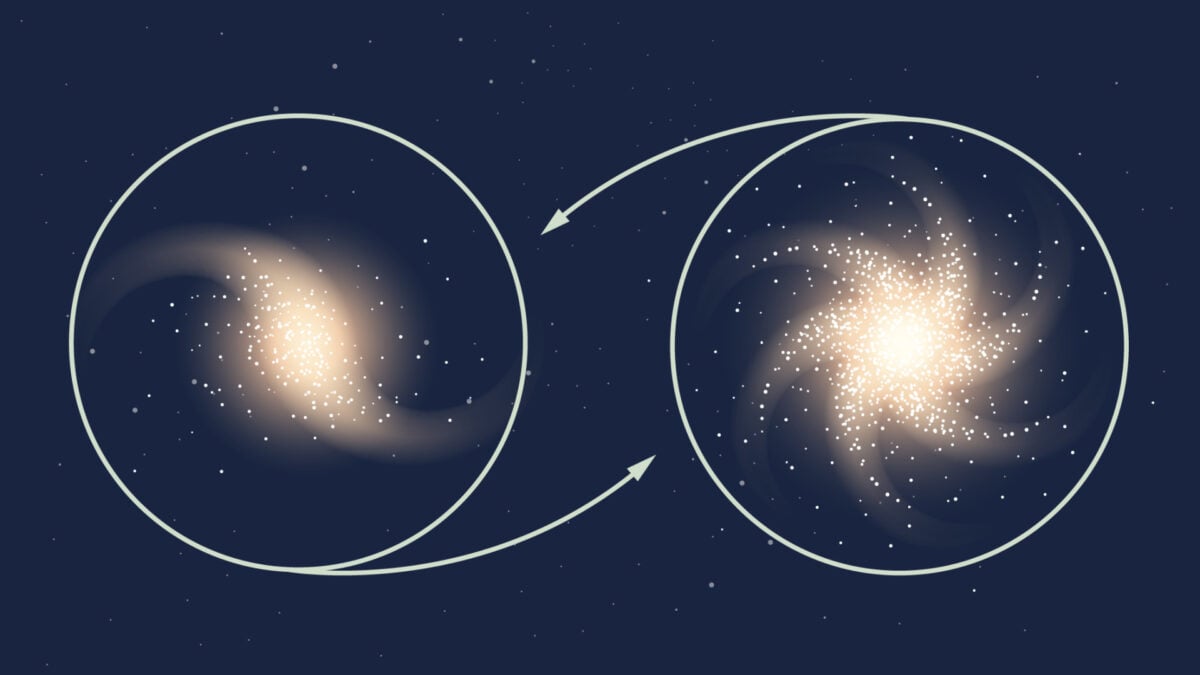
In the 1970s, famous astronomer Vera Rubin discovered that rotating galaxies appear to defy the laws of gravity. By the way, according to Newton’s logic, stars farther away from the center of a galaxy should orbit more slowly than stars at the center, where starlight is concentrated. But Rubin’s observations revealed that just the opposite is true: stars in the periphery are moving just as fast.
Gallardo said a similar discrepancy exists in galaxy clusters, some of which have “velocities that are too high for the amount of material that can be seen.” “That’s the central mystery: Either gravity behaves differently on very large scales, or the universe contains additional matter that we can’t see directly.”
plunge into dark matter
To address this problem, dark matter, an invisible substance that probably makes up 85% of the mass of the universe, was introduced (in part). Although researchers have not found direct evidence for dark matter, there is a strong consensus that its existence solves many unexplained phenomena in the universe.
Of course, not all scientists believe in dark matter, as it hasn’t actually been discovered yet, and many have proposed alternative explanations. However, many recent studies, such as this extensive dark matter map, consistently reach conclusions supporting the existence of dark matter.
newton, einstein, gravity
This includes a recent study that collected data on galaxy clusters observed by the Atacama Space Telescope (ACT) in Chile and the Sloan Digital Sky Survey in New Mexico. Researchers tracked a specific light source that was emitted about 380,000 years after the Big Bang. Each time this ancient light source passes through a massive galaxy cluster, its motion is slightly distorted by gravity.
In their analysis, the team measured these small changes across hundreds of thousands of galaxy clusters tens of millions of light-years away. This calculation agreed almost perfectly with what Newton and Einstein’s theory predicted about the effect of gravity on this light source.
“Our analysis here is very general and does not depend on any particular cosmology,” the researchers wrote in their paper. However, the modified gravity law was not as successful as the traditional equation, they added. Therefore, if the law of gravity is normal, the contradiction must lie in something we don’t see, something like dark matter.
#Research #reveals #largest #space #objects #escape #Newton #Einstein