
California considering changes to marine protected areas
The ongoing petition process could reduce, expand or add new protected areas along the state’s coastline. A decision is expected to be made this summer.
More than a decade after the state began setting aside portions of its oceans for conservation, change may be coming to California. marine reserve.
States are considering a variety of changes to the network, with some proposals reducing their areas or removing certain protections, but most proposing expanding existing protected areas or adding new protected areas. Levels of protection range from complete bans on commercial fishing and certain recreational activities to very limited permits. The California Department of Fish and Wildlife is currently conducting a review. dozens of suggestions Input from tribes, environmental groups, fisheries, and other stakeholders.
The debate comes as pressures on our oceans increase, from tackling plastic pollution and ocean energy to rapidly rising temperatures that have caused the worst marine die-offs ever seen in recent years.
In the previous division, advised to deny All 10 non-tribal proposals. They have not yet released recommendations on the remaining five petitions from tribes. A new protected area has been proposed The Santa Ynez Band of Chumash Indians encompasses approximately 9 square miles off the coast of Santa Barbara.
The final decision to approve or deny the petition is 5 members appointed by the governor Member of the state Fish and Game Commission. A decision is expected to be made this summer.
Some say the state is not being bold enough in its efforts to strengthen protections for marine life, while others argue that existing networks are strong enough. However, there is agreement that marine protected areas can be a powerful tool in promoting certain fisheries and building resilience to climate change.
How to participate in the process
Each region’s proposals will be discussed at the next upcoming public meeting.
Proposals for Del Norte and Monterey Counties
- when: April 21st 8am
- where: Elks Lodge San Mateo
- online: Join the livestream here.
San Luis Obispo County, Santa Barbara County, and Northern Channel Islands Proposal
- when: May 5th and 6th, 8am
- where: Hilton Garden Inn Goleta
- online: Join the livestream here.
Proposals for Los Angeles County, San Diego County, and Catalina Island
- when: May 19th 8am
- where: Holiday Inn Express San Clemente
- online: Join the livestream here.
See full details of all meetings here. Search all suggestions here.
Creating an underwater shelter
California began the process of protecting areas off its coast in 1999. Marine life protection law Signed into law. This began the process of establishing an interconnected network of marine protected areas off the state’s coasts.
But the process to achieve this was long and difficult, delayed by conflicts of interest and political infighting. It was not until 2012 that the state completed its existing coastal network of more than 120 underwater refuges.
The network protects just over 16 percent of California’s coastline from fishing and other activities. The state’s goals, codified by Gov. Gavin Newsom’s executive order in 2020, are to: It is to protect 30% Reduce its land and water area by 2030.
The science of marine reserves
Marine reserves have improved the health of aquatic ecosystems.
state reviews of its network; Released in 2023Marine reserves were found to be largely functional, supporting larger, healthier and richer populations of many species, as well as creating “spill-over effects” that promoted certain lucrative fisheries, such as lobster, outside the reserves’ boundaries. For example, 2021 study They found that the designation of protected areas off the Channel Islands resulted in a 35% reduction in fishing grounds, resulting in a 225% increase in total lobster catches just six years later.
Marine protected areas have also been found to improve the resilience of some species in the face of climate change, as oceans absorb nearly a third of the carbon pollution in the atmosphere and about 90% of the excess heat generated by pollution.
UCLA researcher Kyle Kavanaugh and his team Analyzing satellite data of kelp forests We investigated the California coast in the decades before and after the state protected areas were established, focusing on changes following the severe marine heat wave of 2014 to 2016.
“Marine protected areas have recovered faster and more strongly than non-protected areas in Southern California,” Kavanaugh said.
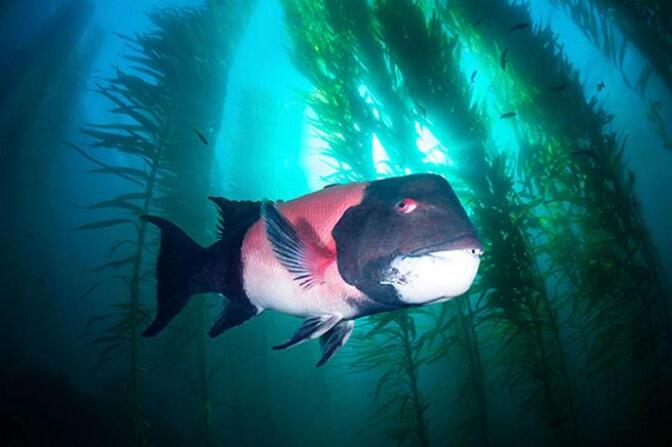
Sheepshead fish are natural enemies of sea urchins and can destroy kelp forests.
Provided by: Laguna Beach Bluebelt Coalition
)
He said this was likely because these areas shelter predators of the sea urchins, which feed on kelp and could destroy entire forests if left unchecked. Natural enemies such as lovebirds and lobsters can be found in Southern California waters.
But in Northern California, the story was a little different. Kavanaugh’s team found that marine reserves do not have the same rebound effect on kelp forests there, likely because the predators of sea urchins in the north are sea otters and starfish.
“Otters are protected [by the state] “Anyway, starfish have basically become extinct throughout California due to starfish wasting disease,” Kavanaugh said, adding that the disease has caused a proliferation of sea urchins in the north, wiping out about 85 percent of kelp forests in just the past decade.

Seals swim in a marine sanctuary off Laguna Beach.
alex caudell
/
Provided by: Laguna Beach Bluebelt Coalition
)
While more protection is likely needed (and is becoming more complex as climate change alters ecosystems), a comprehensive approach to protected areas is not a silver bullet, Kavanaugh said.
“There are different things going on in different places, and there is simply no one-size-fits-all approach,” he said. “In a warming world, we may lose kelp in certain areas, so it’s important to determine which areas are more tolerant of temperatures and protect them.”
Kavanaugh emphasized that it is important to understand the specific challenges to kelp forest growth or decline in different regions. At the same time, California’s network of marine protected areas is still young (just over a decade of protection, compared to the more than 150 protected areas in many national parks), and there is much to learn about the role they play in promoting overall ocean health.
“These are infant sanctuaries, which means we haven’t yet learned how they work,” said Douglas McCauley, an ecologist at the University of California, Santa Barbara. “It also means we are only beginning to understand how they mature and the benefits they produce over time.”
Competing interests, a common connection to the sea
For Chris Voss, specificity regarding the benefits of specific marine reserves is key.
Voss is a lifelong commercial fisherman and president of a nonprofit organization. Santa Barbara commercial fishermen. He said marine reserves benefit some industries, such as lobster, but not all industries, such as sea urchin fishing.
He argues that the existing network is strong and further regulation will harm the fishery, which has been in decline over the past 20 years. Of particular concern to him are proposals to expand or add entirely new marine protected areas.
“We are all small, independent businessmen with families and children who want to make a living from the ocean and at the same time produce high-quality food sustainably from the marine environment,” Voss said.
his group is Pacific Coast Fisheries Association Federation And a handful of recreational fishing groups are asking state commissioners to reject the proposal.
“They didn’t put their first network on low-value real estate in the ocean. They put it in very high-value real estate in the ocean,” Voss said. “Fishing communities have adapted.”

Seagulls gather near a fishing boat in Northern California.
brian van der burg
/
Los Angeles Times (via Getty Images)
)
He pointed to increasing pressures on the industry, including expansion of offshore wind and oil drilling (both of which the group opposes) and aquaculture efforts, as well as science that shows not all marine reserves benefit marine life in the same way.
Voss said, for example, sea urchin fishermen could help reduce the overabundance of kelp-eating sea urchins in some areas. Such efforts have not yet been scaled up, and urchins in kelp barrens are not very lucrative, but some researchers say urchin fishing could be a potential management tool before kelp forests collapse.
“There are nuances that we have to accept,” Vos said. “We need to consider and understand the complexities of different fisheries and their impacts, and make decisions based on a more complete understanding so we can achieve a win-win situation.”
Blue band off Laguna Beach
Laguna Beach Ocean Defender, Recreational Fisher and Diver proposed Expand the marine reserve to completely encompass the city’s coastline. This region is an important link in the genetic dispersion of marine life between Palos Verdes and La Jolla, and is also a major attraction for marine tourism.
“Marine life within the Laguna Beach Marine Sanctuary is thriving, but as soon as you cross the border, the marine life population dwindles,” said the nonprofit’s Mike Beanan. Laguna Bluebelt Coalition. “The kelp forest that was in South Laguna is gone.”
A recent study commissioned by the Laguna Blue Belt Coalition found that Orange County Coastal Manager We brought Reef Check, a UN-approved underwater research organization, to Laguna Beach. where they found Outside the protected area, only female sheetheads exist, and kelp-eating sea urchins are rapidly increasing. Female sheep, unlike males, do not eat sea urchins (all sheep heads are born as females and then turn into males) as they grow olderwhich may take decades). Sheepshead are targeted by spearfishers and commercial fishers in the area.
“Without the sheep heads, the urchins would take over and eat the roots of the kelp forest, and the kelp forest would disappear,” Mr Beenan said.
“For centuries we thought the ocean was an inexhaustible source of food, but we are now discovering that this is not actually the case,” he added.

Tidal pools in Laguna Beach.
Mike Stith
/
Provided by: Laguna Beach Bluebelt Coalition
)
Beanan, a lifelong diver who grew up in a working-class family and often fished for food off the coast of Orange County, said he had hoped the petition process would eventually lead to full protection, but the Fish and Wildlife Service recommended rejecting the proposal to protect all of Laguna Beach’s shoreline.
Local fishermen oppose the expansion. Beanan and Orange County Coastal Manager Ray Hiemstra, who is also a recreational fisherman, said they understand the concerns of local fishermen about expanding protections.
“Sacrifices will have to be made, and we don’t want to downplay the impact on commercial fishermen,” Hiemstra said. “But I think this is a small, incremental and necessary step, and now is the time and process where we can take action on it.”
#Californias #marine #sanctuaries #revitalized #oceans #expand #contract