
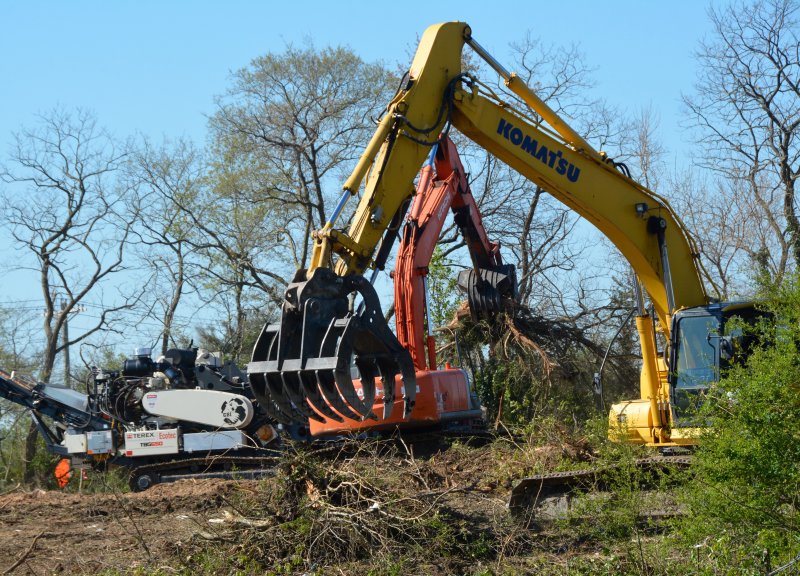
After losing 43,000 acres of forest in Sussex County in less than 25 years, Sussex County Council has begun the process of enacting regulations to limit the removal of trees for new housing development.
But as the proposal was outlined at the April 14 meeting, Councilwoman Jane Gruenebaum said the planned changes may not go far enough.
For decades, much of the county’s rural areas have been cleared of forests to make way for single-family homes, with few restrictions.
According to the Delaware State Forest Service, Sussex County lost 43,000 acres of forest between the 1990s and early 2020.
“We’ve seen it time and time again where they come in and just clear-cut and strip the land completely bare and start all over again,” City Councilman John Lilley said at the April 14 City Council meeting. “We hope this will alleviate that.”
Grünebaum said many people don’t understand the importance of forests.
“Too often we think of them as just beautiful things,” she said. “Forest conservation is not a Bambi issue in terms of economic value, human health value, and flood mitigation value. It’s not just about being pretty.”
While outlining the forest preservation proposal with Assistant County Attorney Vince Robertson and State Forester Kyle Hoyd, County Administrator Todd Lawson said the proposal will be presented at the City Council meeting on Tuesday, April 21st.
This would begin a review by the County Planning and Zoning Commission, followed by the County Council holding public hearings and a vote by the Legislature before a possible review.
The only forest protection regulations currently on the books are parcel buffer requirements. Critics say forest protection is ineffective.
The proposed rule includes a section on forest conservation and a section on tree planting.
Tree planting regulations set the minimum number of trees that must be planted in a development. Forest conservation can contribute to compliance.
The plan was one of 20 recommendations by a land-use reform working group established by the county council in early 2025 to find ways to redirect and improve housing developments that have spread across the countryside.
Lawson said the rule will be added to an existing section of county code. Robertson said it applies to residential developments that include mixed-use housing and commercial space. The exceptions are small subdivisions with fewer than five homes, Sussex County Rental Program projects and subsidized housing, he said.
Developers must hire a certified forester to draw stand boundaries for forested properties. Tree species, age, condition and location, area, hundred-year floodplain boundaries, and the size of areas designated as valuable forests to be conserved will be evaluated.
“It’s a level of detail that doesn’t exist today,” Lawson said. “And certainly a very high level of detail that lends itself to our review.”
Under the rules, tree felling will be limited to 50% of areas deemed valuable in rural areas and 30% in growing areas. Lawson said this will help push development into areas where the county wants to grow and has the infrastructure to support it.
The proposal would also reduce the number of homes that could be built in rural areas, Leary noted.
Leary said the presence of trees on a proposed development site would not prevent development.
Clear-cutting forests is not prohibited, but developers must plant trees according to methods prescribed by law.
“That’s a real problem,” Grünebaum said. “You can’t put saplings back in place of old-growth forest. That’s just ridiculous.”
Mr. Hoyd offered to help the county consider the project in the short term.
“Our services are here to help people through this whole process until they get used to it,” he said. “You can see where the problem is and where you need to massage.”
The county is expected to deal with many competing interests as it moves through the approval process.
“Governments are trying to find a balance between property rights and people’s pressing concerns about things like the environment and forest conservation,” Lilly said.
“Certainly there are camps that think this goes too far and there are camps that think it doesn’t go far enough,” Lawson said. “It’s up to you to decide where we land.”
#Sussex #focuses #forest #protection #laws