
Particle accelerators are among the most powerful tools ever built by humanity, dramatically accelerating discoveries in physics, chemistry, materials science, and biology. New technologies developed for accelerators are critical to many modern advances, from producing life-saving medical isotopes for cancer treatment, to breakthroughs in nuclear fusion research, to the permanent removal of chemicals in water.
But particle accelerators are complex creatures. State-of-the-art particle accelerators take years to research, design, and build, with tens or even hundreds of thousands of devices all working together to deliver a wide variety of particle beams.
“MOAT’s ultimate vision is to fully integrate AI into the design, construction, and operation of accelerators, fundamentally changing the pace of discovery and resulting innovation.”
Jonathan Jarvis, Fermilab
To address this complexity, Fermilab is playing a central role in the multi-office particle accelerator team known as MOAT. MOAT is creating integrated, advanced artificial intelligence systems that are embedded throughout the particle accelerator lifecycle to improve efficiency and innovation.
“MOAT’s ultimate vision is to fully integrate AI into accelerator design, construction, and operation, fundamentally changing the pace of discovery and resulting innovation,” said Jonathan Jarvis, MOAT collaborator and director of Fermilab’s Accelerator Research Division.
The U.S. Department of Energy’s Genesis mission is a historic effort to advance AI and accelerate scientific discovery. MOAT is part of the Transformational AI Models Consortium (ModCon). Fundamental to this mission, ModCon will develop and deploy self-improving AI models that leverage DOE data, facilities, and expertise.
Researchers from DOE national laboratories including Berkeley, Argonne, Fermilab, Jefferson, Oak Ridge, SLAC, and Brookhaven are collaborating to develop MOAT.
“There are so many applications for accelerators,” said Jean-Luc Bey, director of the Advanced Modeling Program at Lawrence Berkeley National Laboratory and director of the MOAT project. “They’re really having a big impact on a lot of areas.”
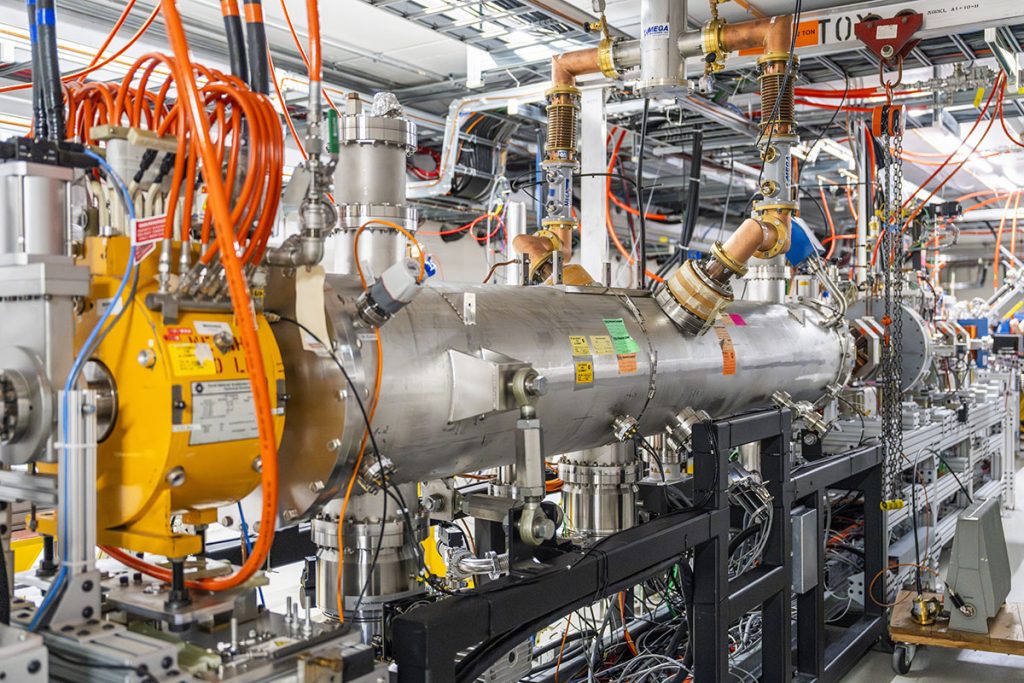
Fermilab’s accelerator technology test facility, called FAST/IOTA, will serve as the primary demonstrator for MOAT’s AI tools. FAST/IOTA also provides flexibility for testing across several different types of accelerators and particle beams.
MOAT’s AI system is still in the early stages of development, but MOAT recently submitted the first demonstration of its work to the DOE Office of Science. The showcase highlighted the team’s initial deployment of the Osprey AI tool. This tool uses AI agents to speed up certain tasks by 100x. AI agents are autonomous software systems that can reason, plan, and perform actions with minimal supervision and are a key element of MOAT’s approach and long-term vision.
“Typically, each of our labs develops its own standalone prototype,” said Thorsten Herert, MOAT collaborator at Berkeley Lab and developer of Osprey. “The Genesis mission required our community to come together to jointly develop and deploy this new AI software.”
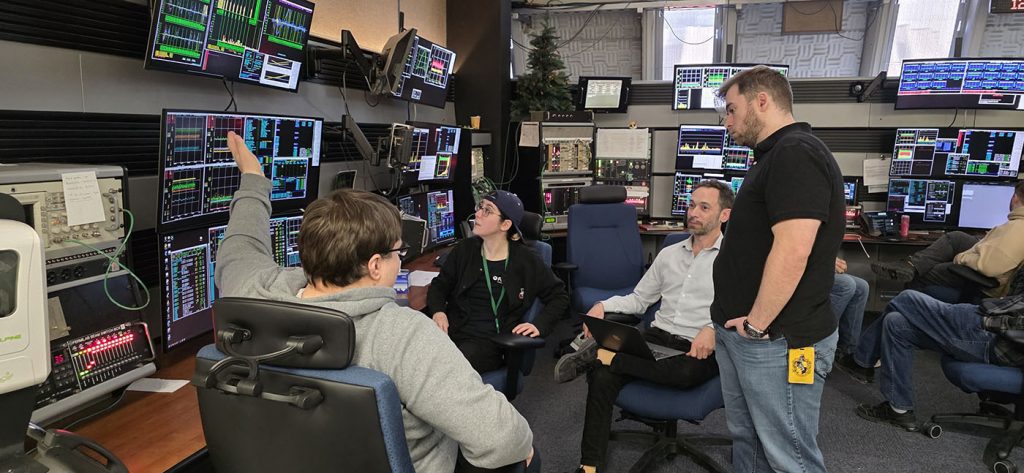
One direct path to optimization lies in the decades of knowledge generated from operating particle accelerator complexes like Fermilab. Accelerator operators are at the heart of these systems, ensuring that the accelerators are operating optimally and delivering particles to experiments. When teams respond to errors within a complex, it is important to be able to search for problem-solving success stories handed down from previous operators. MOAT’s AI system is trained on all of these documented fixes from Fermilab and other DOE accelerator complexes and provides immediate solutions with citations of where the information was found.
“The Genesis mission required our community to come together to jointly develop and deploy this new AI software.”
Thorsten Hellert, Berkeley Lab
MOAT will also develop a digital twin of each accelerator complex. These serve as testbeds for virtual diagnostics and speculative beam adjustments before changes are applied. Unlike existing simulations, the virtual twin is interconnected with the real particle accelerator, allowing for a continuous feedback loop. This allows the AI to learn how the accelerator responds to adjustments and evolve the digital twin to more accurately reflect the performance of the actual components within the accelerator.
MOAT’s AI will be able to be integrated into the accelerator’s concept and research and development stages. When fully realized, MOAT’s vision will save billions of dollars, years of effort, and dramatically increase the performance and value of particle accelerators.
“MOAT’s goal is to help discover and extend knowledge in fundamental physics, chemistry, biology, materials science, and more, faster than any other method,” Bay said. “We hope that the resulting research will allow us to increase the amount of research that can be performed, whether it’s for new drugs, nuclear fusion, or other applications of particle accelerators.”
Fermi National Accelerator Laboratory is America’s national laboratory for particle physics and accelerator research. Fermi Forward Discovery Group manages Fermilab for the U.S. Department of Energy’s Office of Science. Visit Fermilab’s website. www.fnal.gov Follow us on social media.
MOAT is a unified effort led by the Department of Energy’s Berkeley National Laboratory in partnership with Fermilab, Argonne, Brookhaven, Jefferson, Oak Ridge, and SLAC National Laboratories.

Fermilab Advances National AI Genesis Mission
March 19, 2026
The Genesis mission leverages the power of the U.S. Department of Energy’s 17 national laboratories, including Fermilab, as well as U.S. research universities and industry partners. This joint effort aims to accelerate innovation by integrating the transformative power of artificial intelligence across the nation’s research landscape.
Fermilab’s FAST/IOTA facility achieves major milestone in accelerator research
March 9, 2026
Fermilab’s FAST/IOTA accelerator test facility has successfully accelerated and stored the first proton beam, marking a major milestone in the institute’s next-generation particle accelerator technology research and development program. This work paves the way for breakthroughs in high-intensity beam physics, artificial intelligence applications, and innovations that will drive future experiments such as deep underground neutrino experiments.
#Fermilab #researchers #develop #tools #advance #future #particle #accelerators