
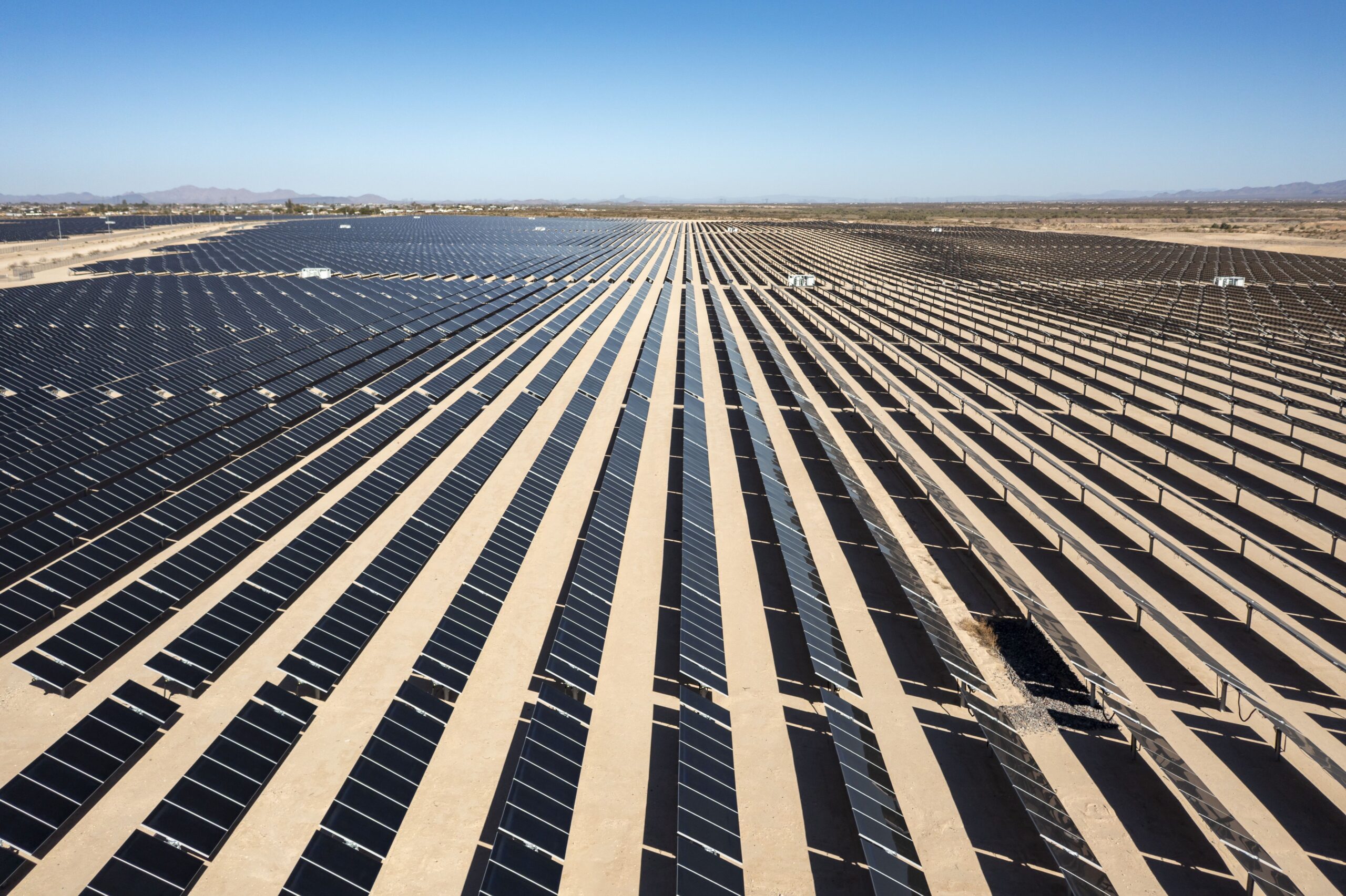
welcome to dispatch energy! Since starting my career in the energy field more than 15 years ago, I have heard about, and in fact, actively advocated for, the declining costs of renewable energy technologies. Between 2010 and 2023, wind turbine prices fell by about 70% and solar panel prices by 90%. Lithium-ion batteries, which can store power for short periods of time when the sun isn’t shining or the wind isn’t blowing, have also shown impressive improvements in both performance and price, with costs falling by about 90% by 2023.
Considering these advances, renewable energy can now compete with existing energies such as coal, nuclear, and natural gas on a per kilowatt-hour basis. So why are electricity prices soaring?
There are three explanations. First, the intermittent nature of wind and solar means that even highly affordable renewable energy relies on enabling technology and infrastructure, such as natural gas plants and extensive transmission grid networks, and consumer prices are set by the system as a whole. Second, wind turbines and solar panels are cheap but increasingly face geographic limitations. The sunniest and windiest locations are not necessarily close to cities, industrial sites, or the transmission infrastructure that can connect generation and demand.
These two factors are compounded by a third factor. This is perhaps the energetic phenomenon that characterizes our time. U.S. electricity demand is increasing for the first time in a generation. The electrification of vehicles and HVAC systems, artificial intelligence and other emerging industries, and the increased use of air conditioning are combining to increase electricity demand faster than new generation sources can come online. This lag will drive up prices, but it’s just the beginning.
Intermittent.
Many renewable energy advocates have come to think that pointing out that the sun doesn’t always shine and the wind doesn’t always blow is a form of trolling, but it’s actually true. And because both are intermittent and have no fuel costs, wind and solar farms primarily serve as a fuel saver for the country’s natural gas and coal power plants (they are “dispatchable,” meaning they can be turned on and off by operators, rather than relying on the weather like renewables). This capability offers substantial economic benefits, especially given the current level of penetration of renewable energy in the U.S. power grid system. But in the long term, grids that increasingly include wind and solar will inherently require significant overbuilding of redundant capacity to smooth out solar and wind stagnation.
Batteries can also help bridge the gap caused by fluctuations in supply and demand, but today’s battery storage systems only store power for a few hours at a time. Wind power cannot handle unexpected days or weeks of drought, nor can it store excess summer energy for use when solar panels are covered with snow in the winter.
The increasing share of wind and solar will require much more power capacity than currently installed to meet current demand as well as demand that increases throughout the year. This helps explain why the capital costs of the U.S. power system are expected to increase faster as more renewable energy is added to the grid.
Geography.
One reason is my mate dispatch energy Columnist Lynn Keisling writes frequently about long-distance power transmission because large transmission lines make it easier to connect sunny, windy deserts and plains to centers of demand. With access to the right infrastructure, renewable energy has the shortest lead time of any power source currently available, so utilities and independent power producers are looking to connect renewable energy to the grid as quickly as possible. But like the nation’s bridges, tunnels, and railroads, the United States has struggled for decades to build a large-scale high-voltage power grid.
This latency imposes a severe constraint on many renewable projects, with hundreds of them stuck in an “interconnection queue.” Power lines have become one of the most difficult types of infrastructure to build in the United States, often taking over a decade to clear overlapping local, state, and federal siting and permitting regulations. If new transmission lines are not built in a timely manner, wind and solar growth could be cut by as much as half by 2030, as one of the leading analyzes of the Biden administration’s energy policy reveals.
But it’s more than just transmission. Communities across America are increasingly opposed to renewable energy projects. In a sign of continued local opposition to data centers, hundreds of counties across the country have enacted siting restrictions for wind and solar projects. Building more clean energy may be a national priority, but it goes against local wishes for new construction and infrastructure in people’s backyards.
And even in areas where renewable energy development is allowed, other geographic features can get in the way. For example, the northeastern United States has a dense population and dark, snowy winters, which are not necessarily a favorable combination for land-intensive and weather-sensitive renewable energy projects. Many eastern states had hoped that offshore wind projects would overcome these limitations, but both economic and political factors have prevented the U.S. offshore wind industry from scaling up.
The United States still has a lot of untapped solar and wind power potential. But these geographic constraints are real, and the evidence is already visible in the annual wind power deployment data, which has fluctuated significantly over the past decade despite falling costs. Solar power is a more modular technology that can be deployed on a rooftop or megaproject scale, and is growing more consistently.
when demand exceeds supply.
The dynamics that have defined the expansion of U.S. wind and solar power over the past two decades have been completely upended by recent technological developments. A steady migration of people to air-conditioned dependent states like Arizona, Florida, and Texas, as well as increased adoption of electric heat pumps and automobiles, are contributing to an increase in electricity consumption for the first time in a generation. But the big story, of course, is AI data centers, whose power consumption could triple (or more) within 10 years.
This means that while wind and especially solar power continue to grow steadily in the United States, data centers are overwhelmingly reliant on natural gas to meet their immediate power needs, at least for now.
AI has also infamously sparked renewed interest in nuclear power generation, particularly in small, advanced reactors that can be installed on-site to produce reliable power. So-called high-tech hyperscalers such as Google and Microsoft are also investing in next-generation geothermal and natural gas with carbon capture to meet data centers’ surging power demands.
In other words, wind turbines and solar panels have become cheap and mature electricity products, but they are unlikely to be enough to meet the growing demand for electricity. No other technology occupies a better position in the defense of renewable energy. Advanced nuclear, geothermal, and carbon capture technologies are still speculative, and even natural gas turbines are in short supply.
But as many energy analysts have warned for years, even if the cost of solar and wind power falls dramatically, renewables will not be able to meet all or even most of the electricity demands faced by modern power grids.
policy watch
- In the February issue of dispatch energyI warned that if Congress fails to pass major permitting reform legislation this year, it will signal a fatal flaw in Congress’ ability to help the United States survive the nascent energy demand boom and the rise of artificial intelligence. The good news is that Democratic and Republican lawmakers and representatives of the Trump administration have expressed optimism about the possibility of a bipartisan agreement. The bad news is that legislative details may not be finalized until August, at which point it may be too close to the midterm elections to craft, amend, and pass meaningful reform legislation.
- With more expensive gasoline and more affordable alternatives to internal combustion engine vehicles, the National Highway Trust Fund faces declining revenue from the federal gasoline tax, which has not been raised since 1993. The trust fund that finances most federal highway and transportation infrastructure spending is already on the verge of bankruptcy and will need alternative or complementary sources of funding to remain solvent over the long term. Earlier this month, the Automotive Innovation Alliance, an auto industry trade group, proposed a one-time weight-based vehicle fee as an alternative to the gas tax. This is one of many abstract ideas to support sustainable investment in America’s roads, including vehicle mileage taxes, carbon taxes, road toll expansion, and congestion pricing.
Read more
- It is difficult to overstate Paul Ehrlich’s intellectual influence, especially when it comes to energy politics. infamous population bomb The authors who predicted mass starvation due to population growth were as committed as others to instilling a culture and policy system premised on limitations rather than innovation and opportunity. Ehrlich passed away last month, and he received a lot of backlash from people like myself and my colleague at the Breakthrough Institute, Vijaya Ramachandran. As written by Jacob Ambinder atlantic ocean“Ehrlich built a reputation for mind-bogglingly radical solutions to avert what he believed was the planet’s imminent destruction. What he failed to understand is that our ingenuity has proven time and time again that the limits to growth are not as immutable as once believed.”
- In his book Substack, Derek Thompson argues that the AI investment boom may be more akin to the advent of electricity than railroads, with the latter being a more common analog among both AI optimists and doomsayers. “I now think it might be useful to study AI as analogous to the early 20th century, the early days of electricity, when builders struggled to keep up with demand but still created a series of tremendous financial and political headaches for the United States,” Thompson writes. “If AI is the next electricity, the question is not whether it will crash, burn out and disappear, but rather who will own this inevitable behemoth as it continues to grow and spread across the economy.”
#Hidden #challenges #renewable #energy