
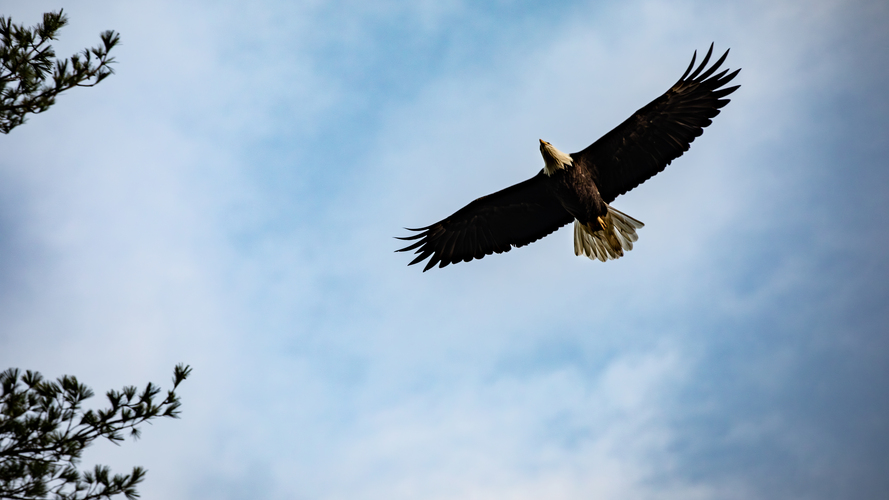
This story is by Robert F. Smith first published April 14, 2026 at The Commons.
Brattleboro resident John Rowley has been observing and photographing bald eagles in the area for the past three years.
“We have 13 nests between Vernon and North Windsor that we monitor,” Lowry said. “All nests were occupied by adult pairs, and in 2025 all eight nests that I regularly monitor had two eagles born and successfully fledged.”
In previous years, “they all had one, but they all had success,” he said.
The return of the bald eagle to the northern Connecticut River basin is one of the great success stories in endangered species recovery.
Biologists say the bald eagle’s rescue was not so much a feat of human interference with nature as it was about removing humans from the way and allowing nature to function as it should.
Young people may have difficulty understanding the excitement their parents and grandparents often show when they see a bald eagle. They did not know a time when these birds did not exist.
But any Vermonter over the age of 50 remembers that not only was seeing a bald eagle in the Connecticut River Valley an extremely rare event, but by the 1930s, bald eagles had all but disappeared from the region. They also remember a time when this magnificent bird was on the brink of extinction.
It was adopted as the national symbol in 1782, but over the next century and a half, the bald eagle population decimated due to habitat loss, hunting, and shooting.
Congress passed the Bald Eagle Protection Act in 1940, prohibiting the killing and possession of the birds.
However, the widespread use of DDT as an insecticide in the 1940s and 1950s caused bald eagle eggs to become too thin. This caused massive reproductive failure, and by 1963 there were only just over 400 nesting pairs of bald eagles in the Lower 48 states.
The bald eagle was one of the first species listed under the Endangered Species Act in 1973, and its population has grown to more than 300,000 individuals in the continental United States, with an estimated 70,000 nesting pairs.
Bald eagles were removed from the endangered species list in 2007.
This is the result of several factors, giving the eagle’s natural resilience an opportunity to develop without environmental threats.
The use of DDT was banned in the United States in 1972, and bald eagles have been the focus of conservation efforts for more than 40 years, including habitat protection and programs to reintroduce the birds to their natural habitat.
In the Connecticut River Basin, all of these factors were essential to the return of the bald eagle, and in the early 1980s the Massachusetts Department of Fisheries and Wildlife (DFW) began a bald eagle reintroduction program at Quabbin Reservoir, 15 miles from the river in central Massachusetts.
DFW imports orphaned eagles from the Great Lakes region and Canada and raises them to adulthood to establish new breeding populations. These eagles eventually expanded into the Connecticut River Valley, with nesting pairs making their way up the river to Vermont and New Hampshire.
Conservation of the habitat that bald eagles need to survive, including cleaning and protecting rivers, riverbanks, and forested floodplains along Connecticut, is critical to bald eagle recovery.
The first nesting pair of bald eagles was recorded in 1988 at Ambagog Lake in New Hampshire. By 2002, nesting pairs were recorded along the Connecticut River in Vermont. In 2008, a successful nest with live offspring was confirmed.
Tall trees suitable for nesting and hunting, and an abundant supply of fish for food, are key factors in the eagle’s recovery. In addition, conservationists are taking some other special practical steps.
Some of the earliest nesting eagles lost their eggs or hatched eagles were eaten by predators such as raccoons, prompting DFW to install metal sheets around the trees to prevent predators from reaching the nests.
By 2023, there will be 32 nests along the Connecticut River between New Hampshire and Vermont, according to the Connecticut River Conservancy. By 2025, New Hampshire will reach a new state record of 128 nesting pairs, and Vermont will have 38 nesting pairs, mostly along the Connecticut River.
build nests above and below rivers
Lowry’s interest in the Eagles goes back more than three years. His “dear friend” Tom Manning said that in the early to mid-1980s, he was part of a volunteer program at the University of Massachusetts Amherst that captured three nesting pairs from Quabbin Reservoir and relocated them to a tidal pool above Vernon Dam.
“The rest is history, all facts. We all owe Tom a debt of gratitude,” Laurie said.
This year, he has tracked several active nests, including one near the Massachusetts border and one below and north of a boat launch in Hinsdale, New Hampshire.
Around Brattleboro, one pair of bald eagles nests near the Riverside Industrial Center and another nests at Retreat Meadows.
Other pairs nest along the Connecticut River in Chesterfield, New Hampshire, and in Westminster, and the pair commonly seen at Bellows Falls nests across the river in North Walpole, New Hampshire.
Laurie said she recently learned there was a nest a few miles north of the North Walpole nest. He also keeps an eye on two other rivers on the Vermont side of the river north of Springfield.
Additionally, birds nest on the shores of the West River north of Townsend Dam and Lake Spofford in New Hampshire.
Lowry said “all the nests now have mothers sitting in them” and some eggs are hatching. He is also keeping an eye on another successful return species, the peregrine falcon nesting in Dummerston.
Volunteers monitor progress
Laurie and Craig Mellish of North Walpole, whose photo accompanies this article, are among the many avid birdwatchers observing and photographing returning bald eagles.
Mellish is well versed in documenting the natural world. He was a member of Walpole-based documentary filmmaker Ken Burns’ creative team and worked as co-producer on the documentary series. National Parks: America’s Best Idea, I visited and photographed over 40 national parks for the project.
Many of these amateur ornithologists share their research results with the Vermont, New Hampshire, and Massachusetts Fish and Wildlife Departments, the National Audubon Society, and other organizations that monitor bald eagles, peregrine falcons, and other wildlife, contributing to the creation of extensive records and databanks on these species.
“We will let everyone know how many chicks will be born in the next week or so,” Rory said. “The Dummerston falcon is in the quarry and active. I will also be keeping an eye on it.”
When Laurie talks about his experiences with these magnificent birds, his enthusiasm is evident.
“The incubation period for bald eagles is about 35 days, and they breed towards the end of February,” he explained. “In January they return to their lifelong nests to rebuild and repair, but if you love wildlife, then all hell breaks loose.
“By the time they fledge in late June, they’re already bigger than turkey vultures, which is tectonically amazing,” Lowry said.
#Bald #eagle #population #booms #region #VTDigger