
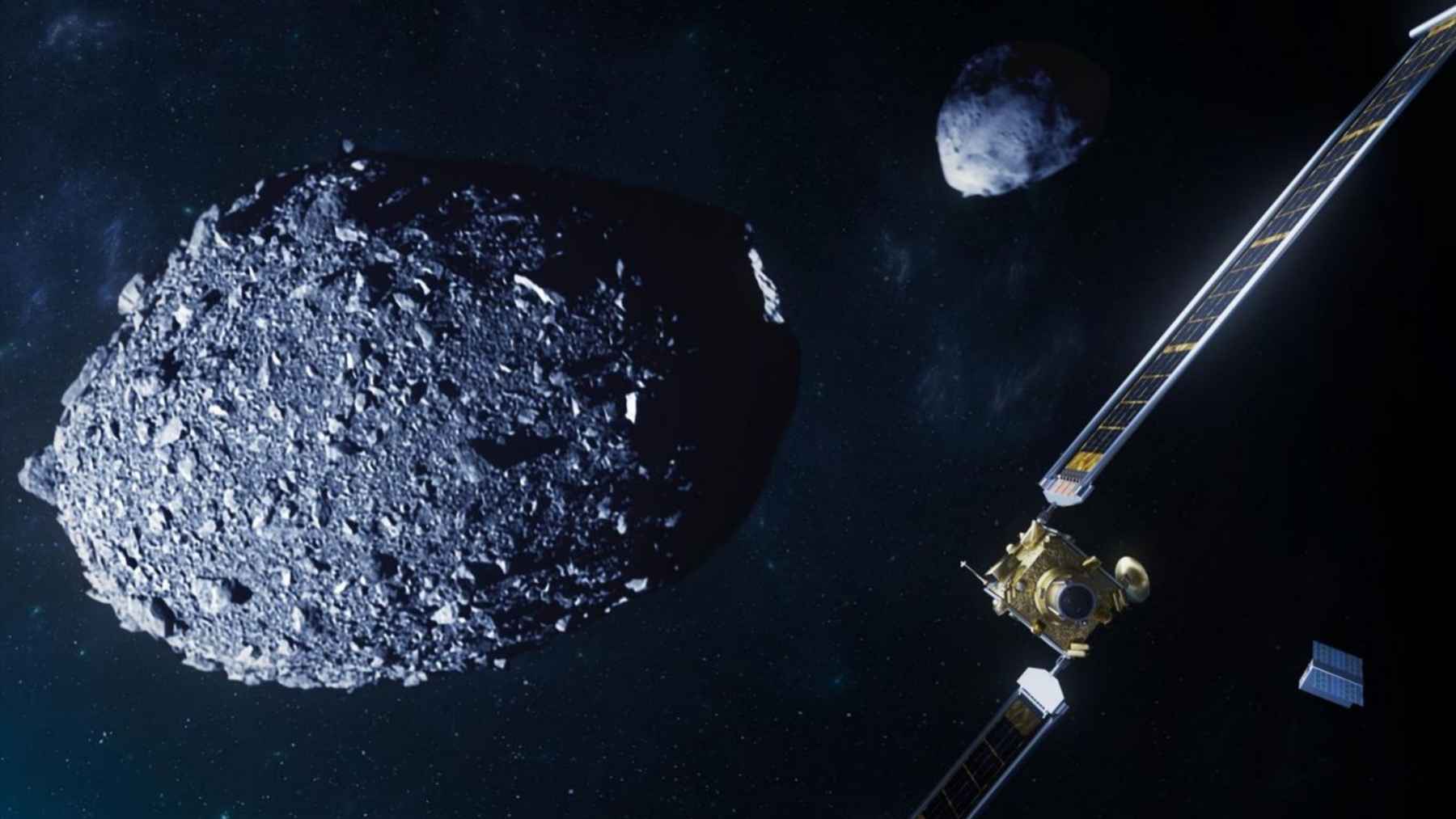
In September 2022, NASA intentionally crashed a spacecraft into a small asteroid called Dimorphos. The goal was simple in theory but huge in result. The idea is to test whether humans can “poke” space rocks to avoid future collisions.
Scientists now claim the blow was even more historic than originally reported. The new measurements show that the collision slightly altered the way the entire Didymos-Dimorphos system moves around the sun, marking the first time that a man-made object has visibly altered the solar orbit of a natural object.
Small changes in time have big effects
The headline numbers seem almost laughably small. The researchers’ analysis shows that after DART’s impact, the binary asteroid system’s roughly 770-day journey around the sun was shortened by about 0.15 seconds.
Does a split second really matter in space? NASA’s Thomas Statler clearly states that given enough time, “even small changes can grow into significant deflections.” This is the whole idea behind planetary defense, and it only works if you act early.
The researchers also estimated that the system’s orbital velocity change was about 1.7 inches per hour. This is slower than the minute hand on a cheap kitchen clock, but small deviations can add up over years or decades.
Binary asteroid collided
Didymus and Dimorpho are held together by gravity and orbit around a common center of gravity. Practically speaking, this means that you can’t push one to subtly affect the other, much like you can hit one’s grocery cart and watch the two drift away together.
Target Dimorphos is approximately 560 feet (170 meters) wide. Its larger partner, Didymus, is about 805 meters (2,640 ft) wide and nearly half a mile long.
Before this new solar orbit result, DART had already demonstrated that Dimorphos could change the way it orbits Didymos. Observations show that the 12-hour orbit of the small satellite around Didymos was shortened by about 33 minutes after the collision.
The rubble did the hard work.
One of the most important points is that the spacecraft itself was only part of the “propulsion.” When DART hit Dimorphos, a cloud of rock and dust was blown into space, and the ejected material carried momentum away from the asteroid.
Scientists explain this boost using the momentum enhancement factor. In this case, the factor is approximately 2, meaning that the effective punch of the debris is roughly doubled compared to a spacecraft impact alone.
The details are not just academic. If future dangerous asteroids are more “heaps of rubble” than solid rock, how that material is ejected could have a big impact on how well kinetic shocks work and how predictable the results are.
Measurements made possible by volunteer astronomers
Proving a 0.15-second change in the sun’s orbit over two years is a sweat-inducing challenge for scientists. Researchers combined radar and ground-based tracking with stellar occultations to find the cause. An occultation is the moment when an asteroid passes directly in front of a distant star, causing the star’s light to twinkle.
There is a human element here that is often overlooked. The team relied on volunteer astronomers from around the world who recorded 22 stellar eclipses between October 2022 and March 2025, often requiring them to be in exactly the right place under cooperative weather conditions. Steve Chesley of NASA’s Jet Propulsion Laboratory said the result “would not have been possible” without these observers.
Why is this important for Earth’s living systems?
It’s easy to register an asteroid’s deflection in “Space News” and move on. But the real danger lies in ecosystems, as major impacts could not only flatten areas but also rapidly disrupt climate and food webs.
The Chicxulub impact 66 million years ago is the clearest reminder. Research and climate modeling show that the impact could inject soot and other particles into the atmosphere, causing darkness and halting photosynthesis, causing severe cooling and stressing ecosystems on land and in the ocean.
At the same time, experts stress that short-term risks are not at panic level. NASA notes that on human timescales, more damaging collisions are rare, and there are currently no known asteroids larger than about 460 feet (140 meters) that have a significant chance of hitting Earth in the next 100 years. Still, “rare” doesn’t mean “absent,” and nature doesn’t refund.
Detecting threats early is the real difference between winning and losing
DART showed that the nudge concept works, but it also highlighted the catch. It takes years of warning to safely deflect something. Because the best strategy is usually not to push in at the last moment, but to gently tap well in advance.
That’s why NASA is building a near-Earth object exploration mission. The space telescope is specifically designed to find and characterize many of the most elusive near-Earth objects, such as dim asteroids and comets that don’t reflect much visible light. NASA and JPL say launch is expected to take place after September 2027.
On a day-to-day basis, the NEO Surveyor is more like a smoke detector than a firefighter. It’s not the dramatic part, but it’s the one that wakes you up in time to go outside.
This study scientific progress.
#Humanity #significantly #change #orbit #celestial #body