
Merritt Island, Florida – On a windy morning in Kerry Park East, a small group of volunteers fanned out along the coastline with clipboards and buckets, staring into the waves as they searched for one of nature’s oldest survivors.
they are part of Florida Horseshoe Crab Watcha statewide citizen science initiative that turns ordinary Florida citizens into front-line researchers of a species that has roamed the Earth’s oceans for hundreds of millions of years.
Holly Abiles, Florida Sea Grant Extension Agent with the University of Florida IFAS Extension in Brevard County, is leading the effort.
She says the program was designed to bring structure to what has previously been an informal and unreliable process.
“Before, all they relied on was people seeing them,” Abiels said. “They say, ‘I saw a horseshoe crab, and I’m going to report it on a spreadsheet or a form.’ That’s how they used to do it. It was kind of haphazard.”
The program has been in place across the state since 2015, with trained volunteers surveying designated locations under specific tidal and wind conditions.
Volunteers set out around new and full moons at high tide, or in Brevard County’s case, when there are strong onshore winds that mimic the tidal conditions of the nearly tidal Indian River Lagoon.
“We’re setting them up to coincide with what would normally be high tide,” Abiels explained. “But we also time wind surveys. In other parts of the state, we only do tidal surveys.”
Research is not just about curiosity. Horseshoe crabs are not actually crabs, but are closely related to spiders and play an important role in the biomedical industry and human health.
“The biomedical industry actually collects horseshoe crabs and takes a third of their blood,” Abiels said. “The medical industry then uses that blood to test for Gram-negative bacteria in products that may be used on humans.”
The test, known as The Limulus Amebocyte Lysate (LAL) test, uses the copper-based blue blood of Atlantic horseshoe crabs to detect bacterial endotoxins in medicines, vaccines, and medical devices.
Amoeboid cells in the blood clot instantly when exposed to endotoxin, providing an ultra-sensitive and reliable safety check.
This is a multi-million dollar industry and depends on a healthy horseshoe crab population.
“If you’ve had a vaccine, if you’ve had any devices implanted in your body, all of those things need to be tested,” Abels said. “And that challenge came from the horseshoe crab.”
Beyond their biomedical uses, horseshoe crabs also support the aquarium trade and are used as bait for eel fishing. Their eggs are the main food source for migratory sandpipers.
“Horseshoe crabs in our area, especially in Brevard County, like to come up when the wind is blowing,” Abiels said. “It’s usually about 25 miles per hour. Sometimes it can go a little faster, but usually within a few hours or so the water level rises high enough to mimic high tide.”
Abiles’ team has two primary research sites in Brevard County: Kelley Park on Merritt Island and Parrish Park in Titusville. She said the Parrish Park site is one of the most productive in the state.
“The Parrish Park property has one of the highest numbers of horseshoe crabs in the state,” she said. “On days with really good wind surveys, you can potentially see thousands of horseshoe crabs.”
Once the horseshoe crabs appear, the work begins in earnest. Volunteers like long-time research participant Lacey Homan carefully collect crabs, keep pairs together and take a series of detailed measurements before releasing them.
“We start at a certain time and walk the same amount of beach each time,” Homan said. “We scan for horseshoe crabs that have come up to nest, and when we find them we record the species – whether it’s a male or female, or whether it’s a nesting group.”
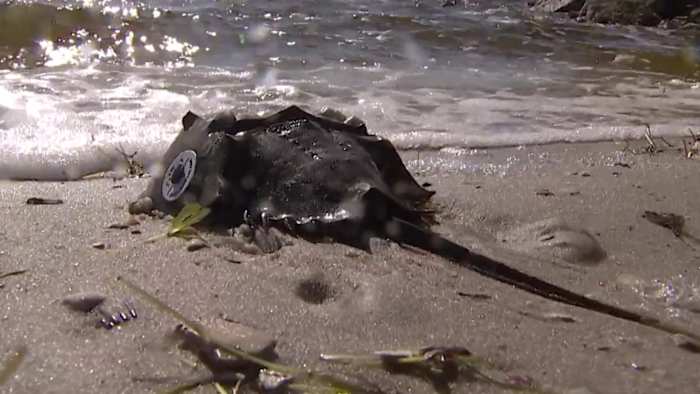
The tag comes from US Fish and Wildlife Service As part of the National Mark Reclaim Program. Volunteers record each crab’s weight, carapace length, estimated age (young, middle, old), and condition. All data is Florida Fish and Wildlife Conservation Commission It is stored in a database and ultimately compiled into a statewide annual report.
“This is all done by volunteers,” Abiels said. “They’re trained to do this, and as you can see, they have very strict procedures. They know exactly what they’re doing.”
Tagging programs have already achieved remarkable results. During a sound-tagging survey in Titusville, a female tracked migrated approximately 15 miles south through the Indian River Lagoon and returned to the same nesting site the following year.
For now, horseshoe crab populations in Brevard County appear to be stable. Surveys have been conducted annually since 2019, and the crabs have consistently appeared season after season, a sign of hope for a species that has survived largely unchanged for hundreds of millions of years.
“We’ve been doing this since 2019, so when you think about the science being long-term, that’s not that long,” Abeles said. “But pretty steadily, we’re seeing anywhere from hundreds to thousands of people with every survey. So we have a good population here in Brevard.”
Still, Abiels points to a growing concern: the loss of sandy shoreline. Horseshoe crabs, like sea turtles, must come ashore to spawn, but an “armored” coastline surrounded by rocks and seawalls prevents their access.
“There are definitely places I can’t go anymore,” she says. “So there are a lot of armored locations along the coastline, so there are only a limited number of locations that have that capability.”
The Brevard County survey will be conducted from February to April.
Anyone who finds a tagged horseshoe crab is encouraged to report it to the U.S. Fish and Wildlife Service.
WKMG ClickOrlando Copyright 2026 – All Rights Reserved.
#Ancient #biology #modern #medicine #Horseshoe #crab #monitoring #Brevard #County