
A little-known federal agency that kills wild animals at the request of ranchers and farmers accidentally killed two federally protected wolves in southern Oregon last summer.
The Oregon Department of Fish and Wildlife’s annual wolf population report, released Friday, reveals for the first time the accidental killing of gray wolves.
It is only mentioned in one sentence in the 12-page report.
The report reveals that the Wildlife Conservation Service, a program under the U.S. Department of Agriculture, was supposed to remove coyotes, but instead killed wolves. At least one of the wolves was a collared male who had traveled from Northern California to Oregon.
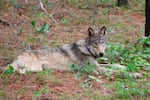
FILE – Two gray wolves were accidentally killed by federal agents last summer, according to a report released Friday. This February 2021 photo provided by the California Department of Fish and Wildlife shows another Oregon-born gray wolf.
California Department of Fish and Wildlife/AP
Many details are still unclear.
Wildlife conservation groups doubt that a federal agency focused on killing wild animals could have made such a mistake.
“It’s completely unacceptable that federal employees and contractors don’t have enough basic knowledge of wildlife identification to know the difference between a wolf and a coyote,” said Bethany Cotton, conservation director for Cascadia Wildlands, an Oregon-based conservation nonprofit. “They vary greatly in size and appearance.”
Wolves, especially males, are considerably larger than coyotes, weighing about 70 to 100 pounds, whereas coyotes only weigh about 25 to 50 pounds.
Tanya Espinosa, public affairs specialist for the USDA Animal and Plant Health Inspection Service, confirmed that U.S. Fish and Wildlife Service law enforcement is actively investigating. Espinosa did not provide details about the investigation or whether it was related to the wolves killed in southern Oregon.
A spokesperson for the U.S. Fish and Wildlife Service declined to comment.
Michelle Dennehy, a spokeswoman for the Oregon Department of Fish and Wildlife, told OPB that CA102, a 2-year-old collared male wolf that was dispersed from the Bayem Seyo pack in Northern California, was killed on July 31, 2025.
Last summer, CA102 killed at least two calves and injured one calf in Klamath County, according to ODFW wolf livestock census records.
Gray wolves, which live in the western two-thirds of Oregon, are protected under the federal Endangered Species Act, so it is the responsibility of the U.S. Fish and Wildlife Service to manage and investigate conflicts between wolves, livestock and wolf mortality, Dennehy said.
“When human-caused wolf deaths occur in areas of the state where wolves are federally protected, the U.S. Fish and Wildlife Service’s Office of Law Enforcement will lead the investigation, including public disclosure,” Dennehy said in an email.
Killing an animal listed as an endangered species is both a federal and state crime.
The Wildlife Conservation Service has long been a controversial and often secretive program under the Department of Agriculture. The agency kills hundreds of thousands of wild animals a year across the country.
In Oregon, wildlife officials killed or removed 155,958 wild animals in 2023, according to the latest public data. Coyotes are the most frequently killed animals by wildlife agencies in the state and throughout much of the western United States.
Conservation groups have long criticized the agency for killing wild animals without sufficient evidence that they pose a danger or threat to livestock, crops or people.
Some investigations have found that the agency has mistakenly killed federally protected wildlife in the past, as well as native animals that did not harm or pose a danger to livestock.
Cascadia Wildlands’ Cotton said it’s also a fundamental tenet of the North American wildlife management model that you need to know what you’re pointing at before you shoot.
“You need to be 100% sure what your target is before you use deadly force,” Cotton said. “And in this case, this person was either incredibly untrained or was comfortable shooting a federally protected species.”
Wildlife agencies have used a variety of methods to capture or kill animals, including scaffolding traps, neck traps, cyanide poisoning and shooting from helicopters.
Wildlife conservation groups say some of these methods are cruel and unnecessary.
“Over the years, there have been reports and controversies about how this program is run and how unresponsible it is to the public,” Cotton said. “This includes internal audits of the government that find it is impossible to track the spending of federal funds.”
Despite record wolf mortality in 2025, Oregon’s gray wolf population continues to grow, reaching 230 animals last year, a 13% increase from 2024, according to the ODFW Annual Wolf Report. A total of 42 wolf deaths were recorded in 2025. ODFW killed 20 wolves in eastern Oregon in response to a livestock-wolf conflict. Gray wolves on that side of the state are not federally protected.
In western Oregon, gray wolves remain protected because they have not yet met recovery goals for the species. It is unclear whether the second wolf killed was the female CA102 was paired with.
“If that’s the case, that means there’s no chance of a new flock forming in western Oregon, because they probably nested in the spring and would have had pups by now,” Cotton said. “That’s a big loss.”
Cotton also questions why the investigation took so long to conduct and why so little information has been uncovered.
The Oregon Fish and Wildlife Commission, a volunteer advisory board appointed by the governor that oversees ODFW, is scheduled to meet Thursday and Friday to discuss the wolf report.
#federal #agency #accidentally #killed #protected #Oregon #wolves #year #state #report #reveals