
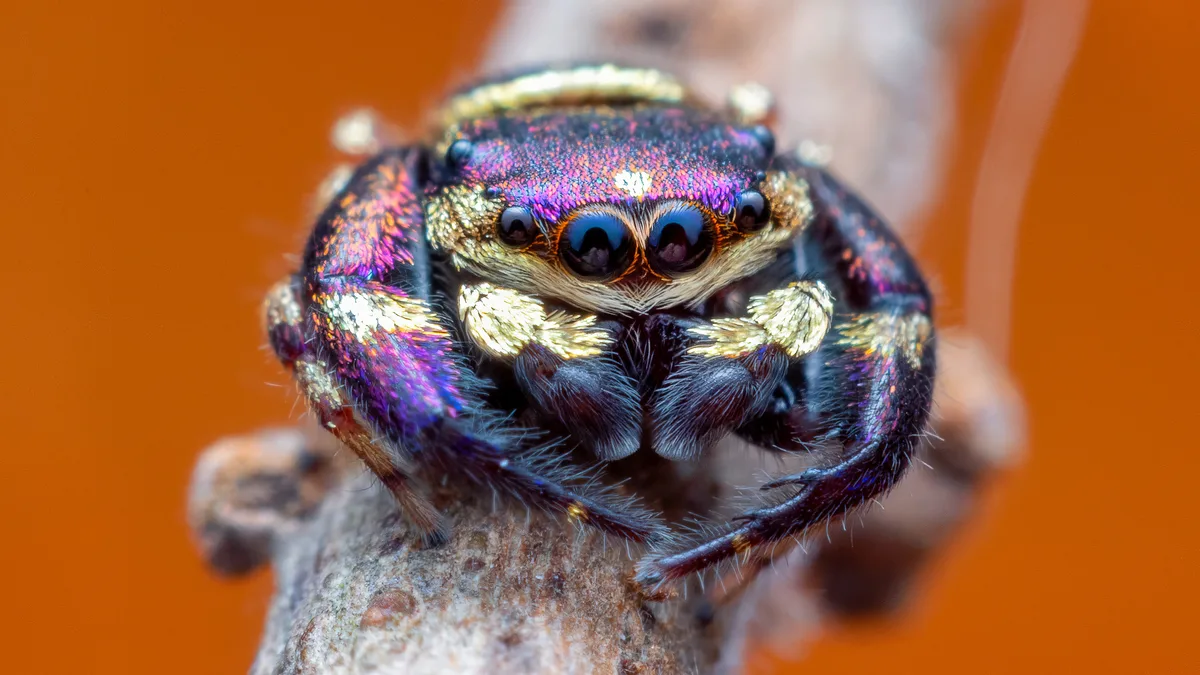
If you were asked to imagine a spider, what would be the first thing you think of?For most people, that imagined creature would be beefy, black, hairy, with long legs and sharp fangs, and probably running around in the depths of a dark cave.
I would like to suggest an alternative to the typical spider look. First of all, they are small and fluffy with adorable big, round, shiny eyes. The legs are stocky and have a kaleidoscope of bright colors.
If you imagine a rainbow-colored kitten, shrink it to the size of a fingertip, and add a few more legs, you can get close to it. It may sound silly, but statistically speaking, this should be the picture we see when we imagine a typical spider.
What is a jumping spider?
Jumping spider (Sarchiidae) Small, adorable, and harmless, there are more types of spiders than any other (over 6,000). This is the largest arachnid family, accounting for 13 percent of all spider species. They can be found everywhere from homes and gardens to the slopes of Everest.
If the world were a just and rational place, spiders would be worshiped as average, adorable furballs rather than evil monsters. Sadly, the world isn’t that kind of place…yet, anyway.
Jumping spiders are animals that are a great combination of beauty, intelligence, and survival skills. Their quick pouncing movements give them their name and allow them to make some of the fastest movements in the animal kingdom.
Recent studies have shown that the acceleration of a jumping spider creates more G’s than a fighter jet. Times are changing, and so is our perception of spiders, thanks to a combination of viral videos, the accessibility of digital photography, and, of course, the sheer charisma of these tiny arachnids themselves.
famous jumping spider
Much of the credit for improving the human-spider relationship goes to a little-known group of Australian spiders that have become internet celebrities.
In 2008, arachnologist Jürgen Otto used his macro photography skills to create what would soon take the world by storm: the mating dance of the Australian peacock spider (maratus flight).
Measuring only 4 mm in diameter, the male jumping spiders dazzle females with their elaborate dance moves. They move their legs from side to side in rhythm, lifting their iridescent bellies covered in rainbow colors.
Otto’s video captured this behavior for the first time and quickly went viral. This was the first of many others to join this craze, including filming other peacock spiders dancing, remixing the video to music, and adding digital maracas, batons, lightsabers, and more.
At that time, only about six peacock spiders were known to science. However, since this species shot to stardom, interest has skyrocketed and the number of described species has increased to more than 100. Each species has its own elaborate markings and performs a unique mating dance.
Are jumping spiders highly intelligent?
As beautiful as a jumping spider is, it’s not just its beautiful face. Scientists have long been fascinated by their amazing intelligence. One species in particular, the jumping spider, is iconic to the region and is said to be the most intelligent invertebrate on land.
Portia spiders, a genus of about 17 species, are smart because they have to be. These small tropical spiders eat other spiders, but other spiders are often reduced in size. Rather than using brute force or powerful poisons or silky traps, they use pure wit and intelligence to destroy their quarry.
They are able to identify different types of spiders by sight alone and plan attack strategies against each specific prey. If it’s a large spider on the ground, they’ll sneak up behind it, sneak between the spider’s hind legs and jump on its back.
Once positioned, they can bite directly into the victim’s head, delivering venom directly into the brain. If it’s a sphere-weaving spider in the middle of a web, the spider navigates a route through the environment that it places on top of the web.
Then they bend over the silk thread, mission: impossible They change styles until they land directly on the Orbweaver’s head, where they can deliver the killing blow again.
When that doesn’t work, the Portia Spiders use the most evil trick in their arsenal. Standing at the edge of another spider’s web, these hunters pluck the threads as delicately as guitar strings. Through trial and error, they find a frequency that intrigues the orbweaver and draw it to the edge of the web.
Orb weavers have poor eyesight and rely on the vibrations of their webs to move through the world, allowing Portia spiders to remain invisible while patiently nudging their food into the perfect position for attack.
The Portia spider’s intelligence has been tested in a lab using a maze. Studies have revealed that they can plan complex routes in advance, memorize the placement of objects, and even count small numbers.
This research challenges the way we think about animal intelligence. Conventional wisdom says that animals need large brains with many brain cells to perform complex cognitive tasks.
However, the Portia spider has a brain smaller than the head of a pin and is capable of complex and flexible actions.
Do jumping spiders have good eyesight?
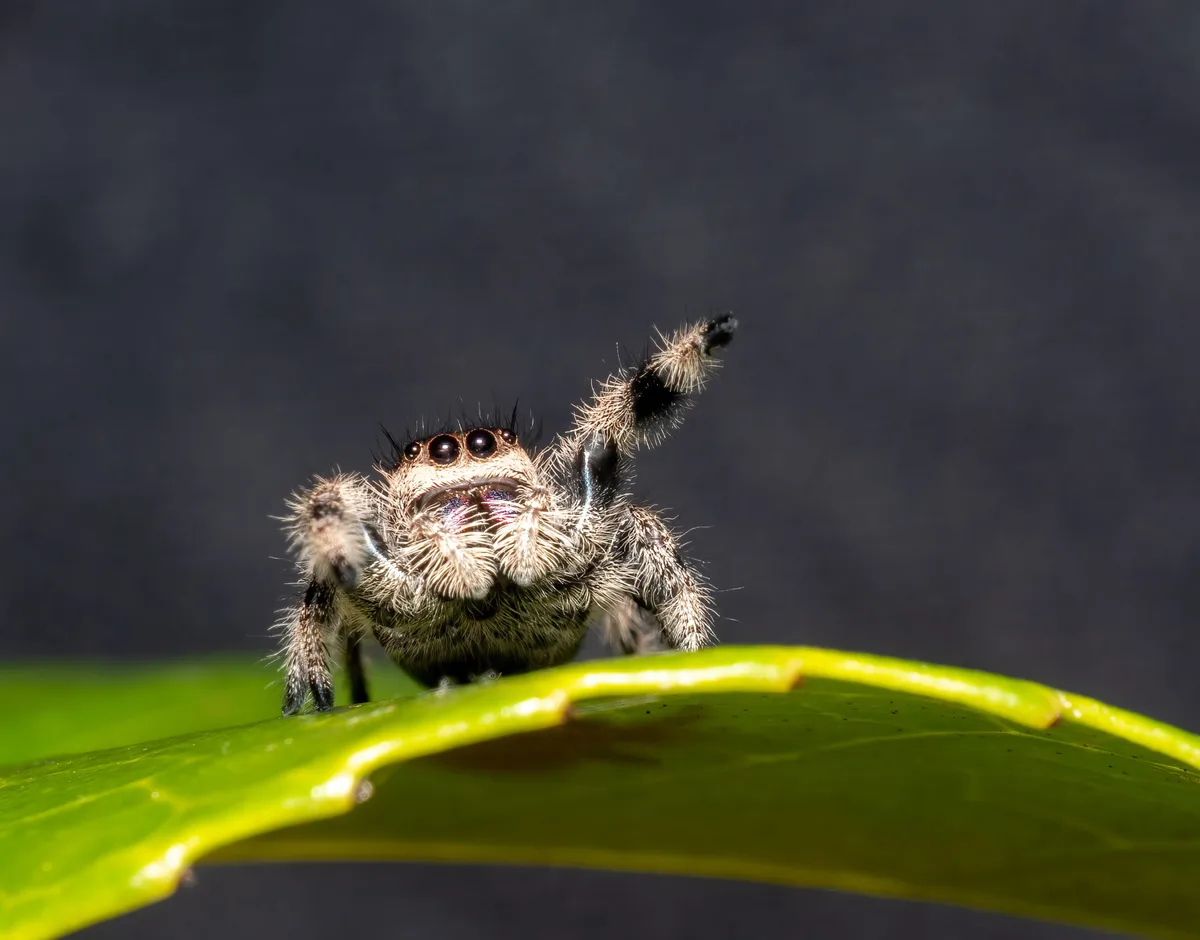
Although we have to admire the intelligence of jumping spiders, their most endearing feature is undoubtedly their large, glossy eyes. Even the most ardent arachnophobe can’t help but find it at least a little cute when shown an image of a tiny female-eyed jumping spider.
While many other spiders have poor eyesight and rely on information such as smell and vibrations to navigate the world, jumping spiders primarily use sight. They have a sharp and narrow field of vision, but cannot rotate their heads or eyes like humans.
Therefore, to scan the environment, the spider must move its entire body. This leads to another attractive feature: their exaggerated movements.
Jumping spiders turn from side to side, tilt their heads playfully, and nod up and down as they view the world around them. By stitching together snapshots of information, you can build a complete and detailed picture of your environment.
When a jumping spider looks in your direction, it gives the impression that it is watching you from top to bottom. You can’t help but personify the way he looks at you with a quizzical look and tilts his head to the side.
It’s easy to understand why humans were able to develop such an affinity for these intelligent, visually-oriented animals. After all, we share those characteristics.
Can jumping spiders dream?
The combination of sharp vision and large brains may be responsible for a particularly human phenomenon: dreams. Dreams are thought to be a byproduct of the brain processing the vast amount of visual information we receive during our waking hours. This is why dreams are associated with rapid eye movement (REM) sleep patterns, as our eyes react to the images we “see” in our dreams.
Jumping spiders, with their large eyes and efficient brains, may have a similar experience. Scientists have documented REM-like sleep behavior. Ivarcha arch typedistributed from Europe to East Asia.
These spiders hang on their threads and sleep. During sleep, they twitch their legs and move their cylindrical eyes from side to side in their heads. This behavior is very similar to REM sleep in mammals, so it is very likely evidence of dreaming in spiders.
Before jumping spiders took the internet by storm, they were already taking the world by storm. There’s something about these species that gives them an evolutionary advantage. Their combination of senses, intelligence, and overall body design has led to them branching out into thousands of species that can survive almost anywhere on land.
How diverse are jumping spiders?
green ant hunting (Cosmophasis bitaniata) For example, the jumping spider of Southeast Asia (Parasilva Wanlessi) settles in damp cavities in fallen bamboo trunks, where they feed on developing mosquitoes.
Then the Himalayan jumping spider (Euphrys the Omniscient), pushing the limits of survival for jumping spiders. This species is found only on the snow-covered slopes of the Himalayas, several thousand meters above sea level. No other animal on Earth has been found to live permanently at such high altitudes.
change attitude
In recent decades, we have witnessed rapid changes in attitudes towards nature. Where once the buzzing of bees warned of a swarm of stinging threats, it now seems like a welcome chorus of spring.
Other insects, nematodes, and creepy crawlies are also increasingly being valued as important components of thriving ecosystems. Could it be a spider next? Can they transform from nightmarish creatures to trusted family companions?
These days, you can scan the aisles of any toy store and find stuffed jumping spiders with colorful, sparkly eyes. cartoons for kids lucas the spider Follow what may be one of the sweetest animated characters ever created.
And just by opening your smartphone, you’ll have access to an endless stream of jumping spider content captured by a small army of passionate spider enthusiasts.
Spiders remain the most feared animals on earth, but our relationship with nature is changing and changing rapidly.
The real evidence of this progress is our relationship with spiders, and whether our preconceptions about spiders will eventually catch up with reality.
Here we start with jumping spiders, which have bright colors, expressive faces, and fascinating behavior. They are a charismatic gateway into the world of eight-legged wonders.
Top image: Male peacock jumping spider. Credit: Robbie Goodall/Getty Images
#Imagine #rainbowcolored #kitten #shrink #size #fingertip #add #legs #time #rethink #tiny #cute #killers #Discover #wildlife