
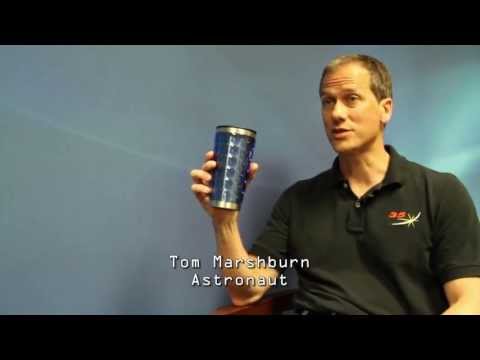
When astronauts return to Earth, it can take some time for them to adjust to the return of gravity.
A viral video of NASA astronaut Tom Marshburn cursing gravity while trying to place a pen in the air was actually a parody. But that’s not the case too much As a new study nearly 20 years in the making explains, what actually happens to astronauts after long periods in space is far from clear.
Researchers from the Catholic University of Leuven in Belgium and the Basque Science Foundation in Spain compared the way astronauts grasp and move objects in the microgravity environment of space and on Earth.
The study involved two female astronauts and nine male astronauts who spent at least five months aboard the International Space Station (ISS).
Researchers found that even after months in weightlessness, astronauts still had visible “gravitational signatures” as they manipulated objects, suggesting that it takes a significant amount of time for the human brain to reprogram its muscle memory.
The main reason we grab objects on Earth is to keep them from falling. On the other hand, in the microgravity environment of outer space, objects do not fall even if they are released. Usually, the purpose of grasping an object is to move it through space, not to hold it aloft.
To test these effects, astronauts completed a series of tasks that measured their grip strength, movement, and ability to hold objects without slipping when manipulating objects designed for the purpose. They repeated this task multiple times before, during, and after the ISS trip.

In the first task, the astronauts held an object between their right thumb and forefinger and moved their arm up and down (while holding the object) to and from a metronome.
In the second task, the same object was fixed in an upright position on a platform in front of the participants, and the participants slid it up and down while grasping the object with their thumb and index finger.
This allowed the researchers to measure astronauts’ sense of the minimum amount of frictional force needed to hold an object without slipping.
In microgravity, arm movements were slower (unless a metronome kept time) and more symmetrical. The forces exerted when lifting and lowering objects were similar.
However, even after several months in orbit, the astronauts had not yet fully adapted to their new zero-gravity environment, and likely applied much stronger grip forces than would be needed in space, anticipating a struggle with gravity when holding and moving objects.
The astronauts didn’t seem to have adapted very well to the grip in space, but when they returned to Earth, they slowly adapted to gravity, and it became clear that something had indeed changed.
“Interestingly, some astronauts verbally reported that the object felt heavier than expected,” the authors note.
“Thus, the robust grip and load force coupling acquired through years of learning on Earth can be broken down after sufficient time in weightlessness.”
After just one day, the astronaut’s movements during the first task returned to their normal asymmetrical state. This means that you need to use more force to lift an object than to lower it. Their bodies quickly adapted to their home environment, but their brains still made some incorrect predictions about the mass of objects.
RELATED: Astronaut returns to Earth with lasting brain changes
“The gradual and imperfect coordination of transitions from one gravitational context to another highlights the predictive nature of the neural processes underlying these behaviors,” the authors explain.
This research Journal of Neuroscience.
#Space #strange #effect #astronauts #sense #gravity