
Every time you drive and use Google Maps to make a right turn or use GPS to tell a friend where you are, Albert Einstein’s two laws of relativity are invoked.
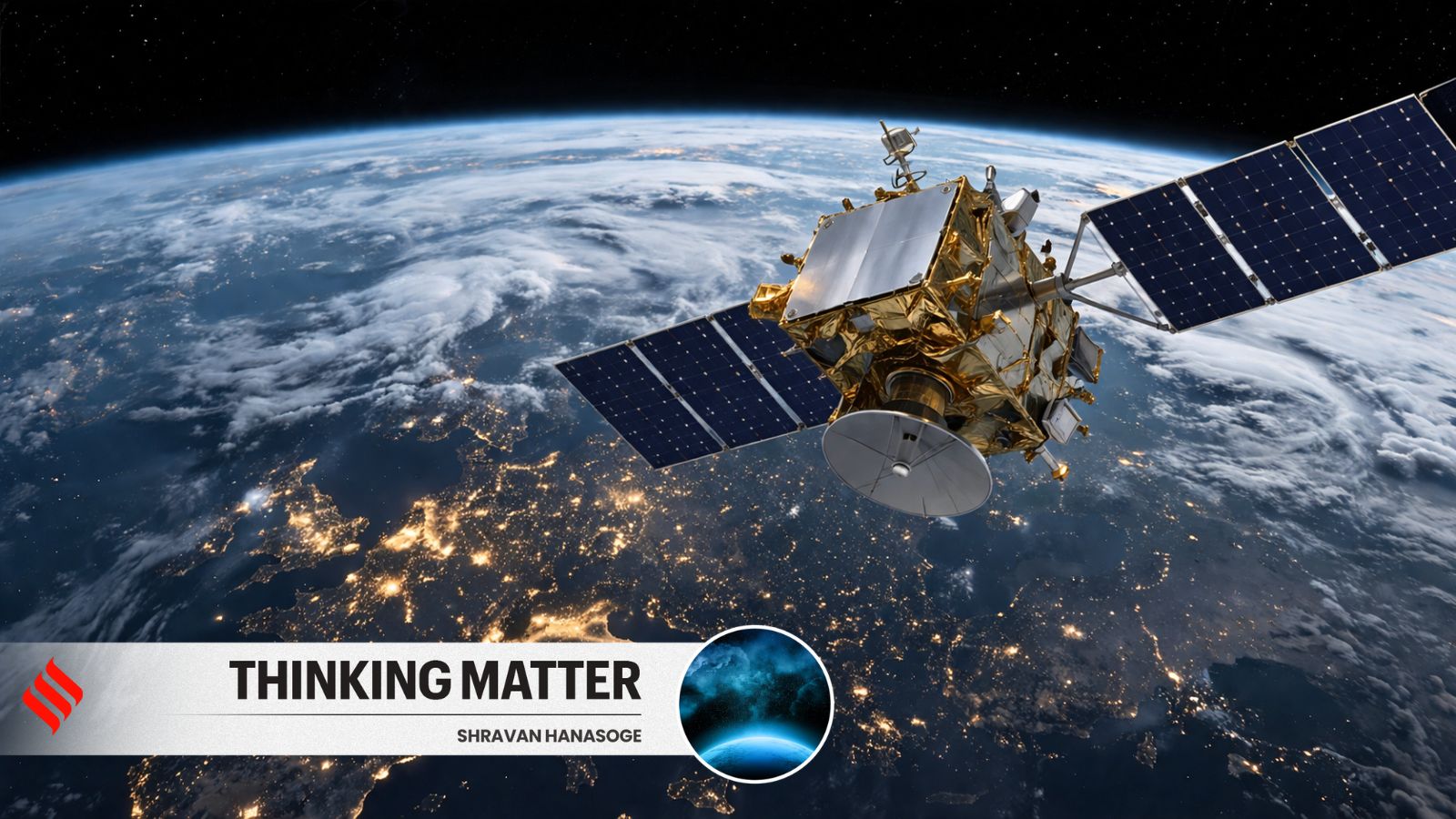
This is the reason. GPS (Global Positioning System) relies on satellites orbiting at high speeds approximately 20,000 kilometers above the Earth. Clocks on these satellites do not tick at the same speed as clocks on Earth.
We can see why thanks to two groundbreaking theories by Albert Einstein: Special Theory of Relativity (1905) and General Theory of Relativity (1915). Here, the two work in opposite directions.
According to general relativity, clocks should speed up by about 45 microseconds per day because gravity is weaker at altitude. The end result is that the satellite clock runs about 38 microseconds faster each day.
The difference may seem small, but if you don’t compensate for it, your GPS location can shift by several kilometers within a day. In other words, modern navigation only works because time itself behaves differently depending on motion and gravity, just as Einstein predicted.
space speed limit
In 1905, Einstein, then a young patent clerk in Bern, Switzerland, published a paper introducing the special theory of relativity that would forever change the way we think about space and time. At first glance, this theory seems almost absurd. According to it, time can slow down and shrink in length, and two observers moving relative to each other can disagree about whether events happened at the same time.
Story continues below this ad
But now, more than a century later, all of these strange predictions have been confirmed. Special relativity is not just a theory. This is a great description of how the universe actually works.
The starting point for special relativity is deceptively simple. The speed of light is constant. No matter how fast it travels, light always travels at the same speed, about 300,000 kilometers per second. This idea is very counterintuitive. For example, if you are on a moving train and throw a ball, anyone standing still will see the ball moving faster than you.
That’s how the daily speed adds up. However, Light refuses to act like that. Einstein took this strange experimental fact seriously and asked, “If the speed of light is always the same, what must be true about space and time?”
The answer led to a fundamental conclusion. Space and time are not fixed backgrounds. They are flexible and adjust themselves so that the speed of light remains constant.
As Einstein later stated, “The distinction between past, present, and future is but a stubbornly persistent illusion” (Letter to Michele Besso, 1955).
time flowing slowly
One of the most famous results of special relativity is the idea that time dilates, or that moving clocks run slower. In 1971, physicists Joseph Hafele and Richard Keating flew an atomic clock around the world on a commercial plane. The clock that returned was slightly out of sync with the identical clock that remained on Earth, just as Einstein’s theory predicted. The difference was small, on the order of billionths of a second, but it was measurable.
Story continues below this ad
In fact, it turns out that time passes differently depending on movement. This is more than just curiosity. GPS satellites orbiting the Earth at high speeds must account for relativistic time dilation. Without these fixes, your phone’s navigation system would be off by several kilometers every day.
Energy and mass: two sides of the same coin
Special relativity also gave us one of the most famous equations in science: E = mc^2
This equation shows that mass and energy are interchangeable. Even a small amount of mass contains a huge amount of energy because it travels the speed of light squared. This idea underlies both nuclear power and nuclear weapons. It is also the power source of the sun, where tiny amounts of mass are converted into vast amounts of energy through nuclear fusion.
Physicist Richard Feynman once said: “It is important to realize that in physics today we have no knowledge of what energy is” (Feynman Physics Lectures, 1964). Relativity does more than just give us a formula; it reshapes our understanding of fundamental concepts like energy itself.
Story continues below this ad
General form of relativity
In 1915, Einstein developed the general theory of relativity, which expanded on the ideas of special relativity to explain gravity. Gravity is no longer seen as a force acting at a distance, but rather as a curvature of space-time caused by objects with mass. To understand what that looks like, imagine space-time as an extended blanket with the celestial body as a tennis ball resting on top of it.
One of the most striking consequences of this theory is that gravity affects the passage of time. A clock in a stronger gravitational field will tick more slowly than a clock in a weaker gravitational field. This means that clocks on Earth run slightly slower than clocks on satellites orbiting above. The difference is measured in microseconds, so it’s very small, but it’s real and measurable.
living in a relativistic universe
When you combine Einstein’s two theories, they tell an amazing story. Special relativity shows that motion reshapes time, but general relativity reveals that gravity does the same, bending space-time itself and subtly changing the sound of clock hands. The same physics that governs black holes and the expansion of the universe are also at work in the satellites above us, silently adjusting their clocks to ensure our maps are accurate.
What started as an abstract attempt to understand light has become a framework for understanding everything from the universe to the most everyday journeys we take. Every time we use GPS to find our way, we are not just navigating Earth, but in some small but profound way, we are navigating Einstein’s universe.
Story continues below this ad
Shravan Hanasoge is an astrophysicist at Tata Institute of Fundamental Research.
#time #GPS #rely #Einsteins #laws #relativity #Heres