
Ordinary matter, the atoms that make up stars, planets, and living things, make up only about 15% of the total matter in the universe. The rest is thought to be due to dark matter, but it has not been directly detected. However, more than half of that 15% remains unexplained, leaving gaps in cosmological models.
This contradiction has long been a challenge for astronomers trying to map the structure and evolution of the universe. Finding this missing component is not just a completeness issue. It directly affects how scientists interpret galaxy formation, large-scale structure, and the behavior of matter over cosmic time.
Detection method using the oldest light in the universe
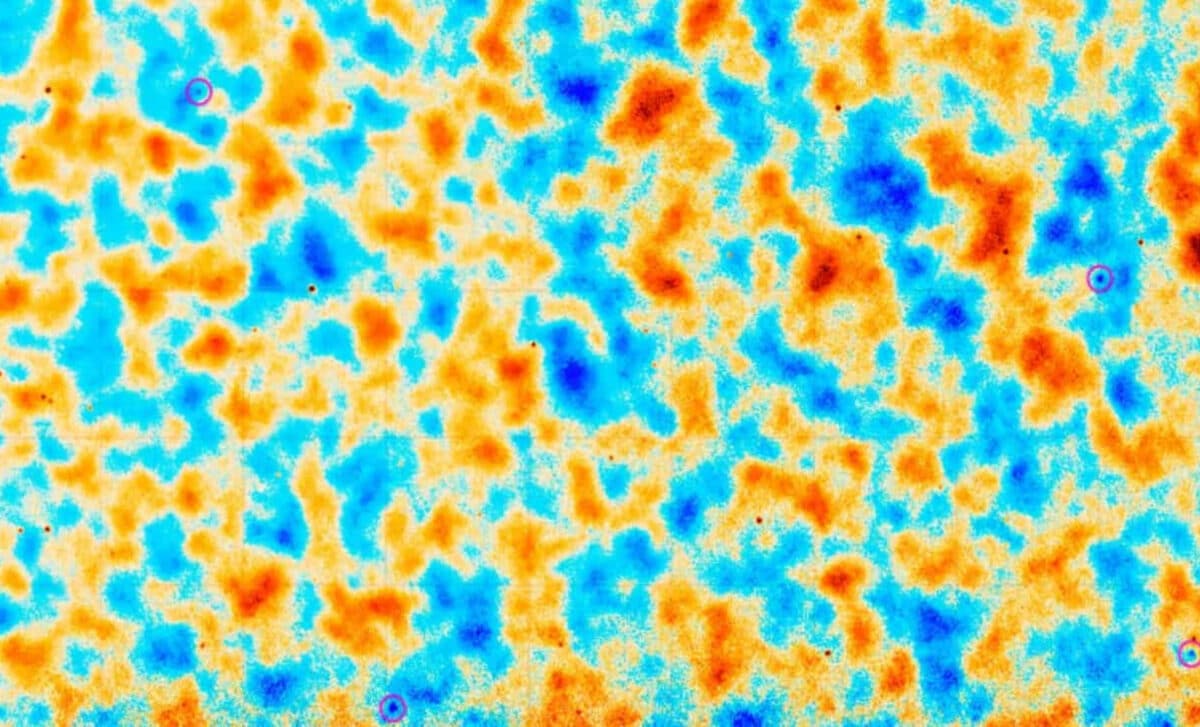
To identify this invisible material, researchers used the cosmic microwave background (CMB), often said to be the oldest observable light in the universe. This radiation acts as a backlight source throughout the observable universe, said Simone Ferraro, a senior scientist at Lawrence Berkeley National Laboratory and the University of California, Berkeley.
Ionized hydrogen gas does not emit detectable light, so it cannot be observed directly with conventional telescopes. Instead, the scientists looked at how the CMB subtly changes as it passes through a cloud of free electrons. This interaction is known as the kinematic Sunyaev-Zeldovich effect and allows indirect detection of invisible materials.
The researchers analyzed the data by overlaying images of about 7 million bright red galaxies observed by the Dark Energy Spectrometer (DESI) in Arizona. These were then compared with precise CMB measurements from the Atacama Space Telescope in Chile. According to ZME Sciencethis combined approach revealed a faint and widespread gas distribution that was previously undetectable.
Diffuse hydrogen spreading beyond galaxies
The discovery indicates that ionized hydrogen gas extends much farther out from the galaxy than previous models suggested. This gas appears to become more detectable the further away from the center of the galaxy, says physicist Borjana Hadjiiska of the University of California, Berkeley.
Researchers observed that this gas spread up to five times farther than previously thought. Rather than crowding around galaxies, they form vast, diffuse halos that blend into the intergalactic medium. This helps explain why previous observations failed to detect the signal. The signal is very weak and widely distributed.
This material is thought to exist as ionized hydrogen formed shortly after the Big Bang. Its diffuse nature made it virtually invisible until methods capable of detecting subtle CMB distortions were applied at large statistical scales.
Black hole activity and its influence on the structure of the universe
The discovery could go beyond solving a long-standing inventory problem and reshape our understanding of galaxy dynamics. The presence of widespread ionized gas suggests that black holes may impact their environment more frequently than previously thought.
One unresolved question, Hadjiiska said, concerns active galactic nuclei (AGNs), which are thought to cycle on and off periodically. These stages release energy and matter into the surrounding space. This is a process known as feedback, which controls star formation within galaxies.
Early signs of such large-scale feedback appeared in 2020, but the precision was not very high. New analyzes based on significantly larger datasets strengthen the evidence for these processes. It also shows that this gas follows the structure of the cosmic web, a vast network of filaments connecting galaxies in the universe.
Understanding the distribution of this gas is a limiting factor in extracting cosmological insights from current and future investigations, Ferraro said. The research will be peer-reviewed at P.physical review letterThe researchers are refining their simulations to better match these observations, especially by incorporating more powerful gas outflows.
These results suggest that the matter missing from the universe may not have existed after all, but was simply too diffuse and weak to be detected until now.
#universes #ordinary #matter #missing #astronomers #theyve #vast #hydrogen #cloud