
2026/04/20
89 view
0 like
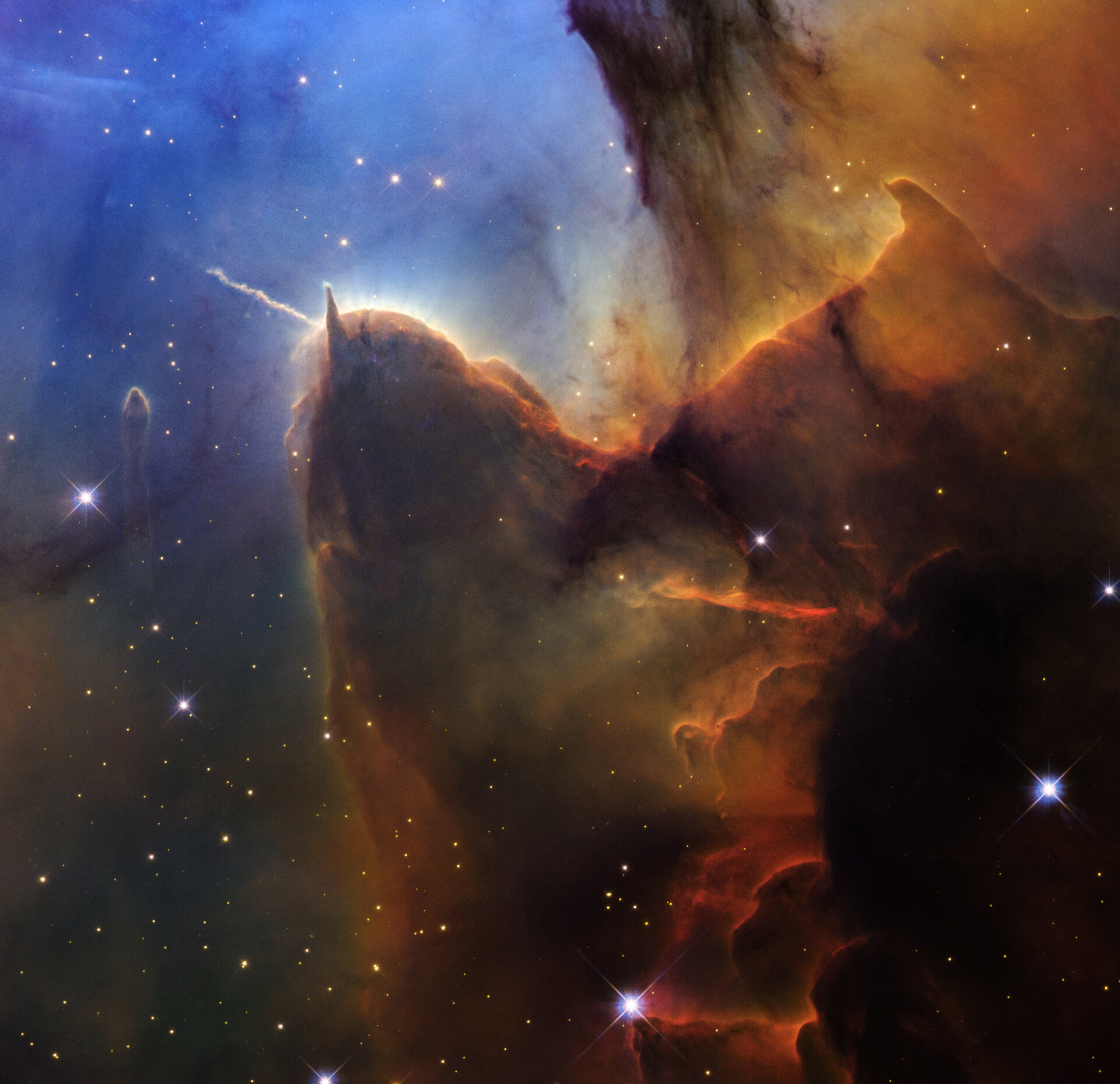
The NASA/ESA Hubble Space Telescope observed its first photographic scene in 1997 to commemorate its 36th anniversary. It is a small part of a star-forming region about 5,000 light-years away in the constellation Sagittarius known as the Trifid Nebula. This image shows change over an incredibly short time scale, giving a sense of awe and wonder at the ever-changing universe.
Trifid Nebula (3 wide-field camera images)
The colors in Hubble’s visible-light images of this shimmering region of star formation are reminiscent of underwater scenes filled with fine-grained sediment flitting through the deep ocean.
Several giant stars outside this field of view have shaped this region for at least 300,000 years. The powerful ultraviolet wind continues to blow giant bubbles, only a fraction of which are shown here, pushing and compressing the cloud’s gas and dust, triggering a new wave of star formation.
Trifid Nebula (with annotations)
This is not the first time Hubble has observed this scene. The telescope observed Trifid in 1997 and now, 29 years later, has used almost its full operational life to show changes in the nebula on human timescales. Why look at the same place again? In addition to being able to observe changes over time, Hubble is also equipped with an improved camera with a wider field of view and higher sensitivity, which was installed during its fourth maintenance mission.
Star formation of “cosmic sea lemon”
Hubble’s view of the Trifid Nebula (also known as Messier 20 or M20) focuses on the “head” and undulating “body” of a rust-colored cloud of gas and dust, resembling a marine sea lemon, as if gliding through space.
The left “horn” of the Cosmic Sea Lemon is part of Herbig Halo 399, a jet of plasma emitted periodically over centuries by young protostars. [1] It is embedded in the head of a sea lemon. Observe the jet expanding. The observed changes allow researchers to measure the rate of outflow and determine how much energy the protostar is injecting into these regions. This measurement provides insight into how newly formed stars interact with their surroundings.
Just to the bottom right is evidence of a counterjet. A jagged orange and red line “runs” down the back of Sea Lemon’s neck, revealing a natural V in the brown dust.
To the right of the “head”, at the tip of the dimmer, more triangular “corner”, is another young star. If you zoom in, you’ll see a faint red dot with a small jet. The green arc above it could be evidence that the circumstellar disk is being eroded by intense ultraviolet radiation from a nearby massive star. The sharper the region around this protostar suggests that its formation may be nearly complete.
Just to the left of the Cosmic Sea Lemon is a small, faint pillar. Much of the gas and dust in this column has been blown away, but the densest material at the top remains.
Stripes and sharp lines provide more clues about the activities of other young stars. Look for wavy diagonal lines near the center that start in bright orange and end in fiery red to find an example. In the image comparison, it appears to be moving, which means it could be a jet fired from another actively forming star buried deep within the dust.
“Sea” of Prism Colors
Explore the Trifid Nebula
In Hubble’s visible-light observations, the clearest view is in the upper left, which is bluer. Intense ultraviolet light from a massive star outside the field of view stripped electrons from nearby gas, creating the glow, and winds dislodged surrounding dust to form a bubble.
At the top of the Cosmic Sea Lemon’s head, bright yellow gas flows upward. This is an example of dark brown dust being irradiated with ultraviolet light, causing the gas and dust to peel off and decompose.
Many ridges and slopes of dark brown material will remain for millions of years as the star’s ultraviolet light slowly erodes the gas. The densest regions are home to protostars [1]hidden in visible light.
The right side is almost completely dark. This is where the dust is the thickest. The stars that appear here may not be part of this star-forming region. They can be close to us, in the foreground.
Next, scan the scene for a bright orange orb. These stars are fully formed and the space around them is empty. Over millions of years, the gas and dust that makes up the nebula disappears, leaving only the stars.
Complete Trifid Nebula (Rubin and Hubble)
Unprecedented longevity, constant discovery
Hubble’s various instruments and the wide range of light it collects, from ultraviolet to near-infrared light, have helped researchers make groundbreaking discoveries for decades, providing new data every day that inevitably leads to further results.
In the past year, Hubble has enabled discoveries ranging from relics of early galaxy formation to galaxies so faint that they are almost invisible to unknown cosmic anomalies discovered with the help of AI. For the first time, researchers have detected an asteroid colliding in another star system, while in our own solar system Hubble incidentally captured the breakup of a comet. Long-held predictions that our Milky Way galaxy will collide with Andromeda in the distant future have been challenged by a new study using data from Hubble and ESA’s Gaia. Hubble also tracked the interstellar comet 3I/ATLAS, which unexpectedly appeared in our solar system last year, helping quickly estimate its size.
The 36th year of Hubble’s spaceflight also brought even more impressive views of the universe. These included the latest images of star-forming region N11 in the Large Magellanic Cloud, the Egg Nebula, the stardust shells that make up the Cat’s Eye Nebula and ESA’s Euclid, and the famous Crab Nebula. Hubble also displayed the smoldering core of M82, the swirling spiral galaxies UGC 11397 and Arp 4, the dust ring around galaxy NGC 7722, the twinkling stars of globular cluster NGC 1786, and the giant galaxy cluster Abel 209.
The telescope has made more than 1.7 million observations to date. Approximately 29,000 astronomers have published peer-reviewed scientific papers using Hubble data collected over the telescope’s 36-year lifespan, resulting in more than 23,000 publications, and approximately 1,100 in 2025 alone. Since 2022, researchers have regularly combined Hubble observations with observations from NASA/ESA/CSA’s James Webb Space Telescope to further their discovery opportunities.
Precautions
[1] A protostar is a mass of interstellar gas and dust that is in the process of collapsing to form a star.
Detailed information
The Hubble Space Telescope is an international cooperative project between ESA and NASA.
link
#Hubble #turns #captures #dazzling #portrait #Trifid #Nebula