
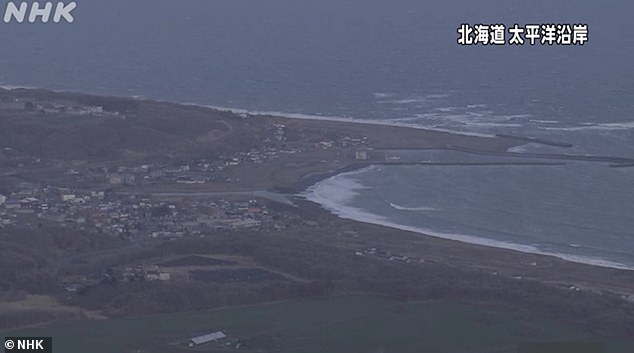
Japan issued a special warning on Monday warning of an increased risk of an earthquake of magnitude 8.0 or greater after strong tremors rocked northern Japan and triggered a tsunami warning.
The Japan Meteorological Agency released a statement saying, “The possibility of another major earthquake occurring is relatively higher than in normal times.”
The warning for the northern region came hours after a magnitude 7.7 earthquake struck the region, shaking large buildings in the capital Tokyo hundreds of miles from its epicenter.
The earthquake, initially estimated at magnitude 7.4, later revised to magnitude 7.5 and then again to magnitude 7.7, occurred in the Pacific Ocean off the northern coast of Iwate Prefecture at 4:53pm (7:53am UK time).
Chief Cabinet Secretary Minoru Kihara said at a press conference that there were no immediate reports of serious injuries or serious damage.
In a separate video conference, a Cabinet Office official said, “It is unclear whether a major earthquake will actually occur, but I would like people to take disaster prevention measures based on the principle that they are responsible for their own safety.”
early Monday morning, Japanese authorities instructed civilians to evacuate urgently given the expected tsunami height of 3 meters (10 feet).
Japanese media reports that tsunamis are also expected in Aomori, Miyagi and Fukushima, but those waves are expected to be only 3 feet high.
Huge waves were seen engulfing vast swathes of Japan’s coastline
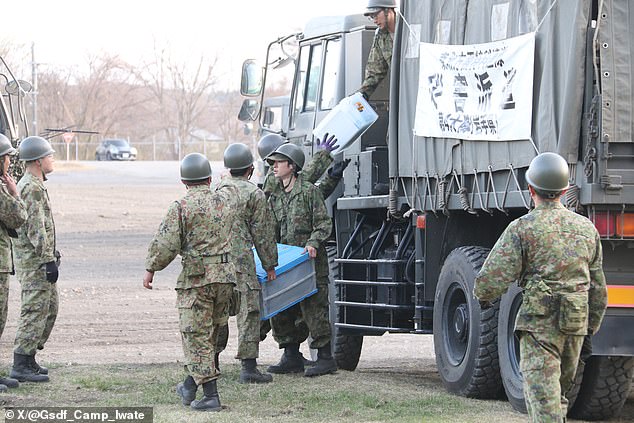
Japanese soldiers have been dispatched to support the disaster area, and several have been seen in Iwate Prefecture.
At 5:32 p.m. local time, waves of 70 centimeters were recorded at the port in Kuji City, Iwate Prefecture.
According to the Japan Meteorological Agency, an 80cm wave hit two minutes later.
The magnitude 7.7 earthquake had its epicenter in the Pacific Ocean at a depth of 6 miles.
The Japan Meteorological Agency urged people near water to “immediately evacuate from coastal areas or along rivers to safe areas such as higher ground or evacuation buildings.”
“Tsunami waves are expected to strike repeatedly. Please do not leave your safe location until the warning is lifted.”
The tremors were strong enough to shake buildings hundreds of miles away in Tokyo, and aerial footage showed huge waves dominating Japan’s coastline.
Japan’s prime minister warned: “We have received reports that there is currently ‘human and property damage,'” he said, but did not elaborate on the extent of the destruction.
Footage taken from inside the cafe in Japan showed signs and hanging lights swinging from side to side.
Another clip showed the flashing lights of an ornate chandelier as decorative lights swayed.
NHK showed a ship setting sail from Hachinohe Port in Hokkaido in anticipation of waves, and issued a warning of “Tsunami!”. Evacuate! ‘ flashed across the screen.
In Aomori Prefecture, on the northern tip of Honshu, Shinkansen service was suspended due to the shaking.
TEPCO officials said there has been no change in radiation levels from the Fukushima plant so far.
It added that no anomalies were detected. Higashitori Nuclear Power Plant in Aomori Prefecture and Onagawa Nuclear Power Plant in Miyagi Prefecture.
A recycled fuel storage company also announced that no abnormalities were found at the interim storage facility for spent nuclear fuel in Aomori Prefecture.
The Prime Minister’s Office announced that it had set up a crisis management team in response to the earthquake.
“If you live in an area where a warning has been issued, please evacuate to a safer place, such as higher ground,” he said at a press conference.
Japanese soldiers have been dispatched to assist in the disaster area, and several have been seen in Iwate Prefecture.
Following the earthquake, the National Weather Service announced that tsunamis were not expected in the U.S. states of California, Alaska, Washington, and Oregon, and that no tsunamis were expected in British Columbia, Canada.
Japan is one of the most seismically active countries in the world, sitting on four major tectonic plates along the western edge of the Pacific Ring of Fire.
Home to about 125 million people, the archipelago typically experiences about 1,500 tremors each year, accounting for about 18 percent of the world’s earthquakes.
Most are minor, but the damage they cause varies depending on where they impact and how deep below the surface.
In 2011, a magnitude 9.0 earthquake triggered a tsunami, left 18,500 people dead or missing, and caused a catastrophic meltdown at the Fukushima nuclear power plant.
In 2024, the Japan Meteorological Agency announced its first special warning regarding the possibility of a “huge earthquake” along the Nankai Trough.
This approximately 500-mile-long ocean trench is where the oceanic tectonic plate of the Philippine Sea is “subducting,” or slowly sliding, beneath the continental plate on which Japan rests.
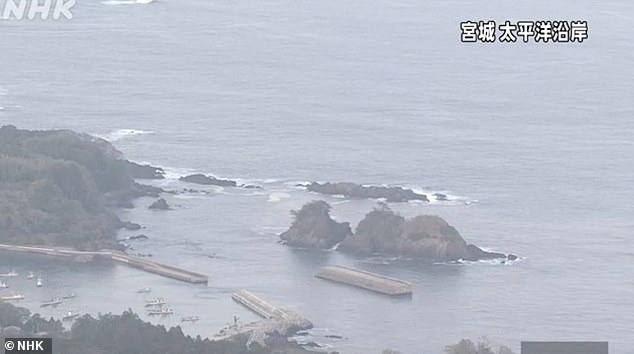
Japan is one of the most seismically active countries in the world, sitting on four major plates along the western edge of the Pacific Ring of Fire (Photo: Japan’s coastline after the earthquake)
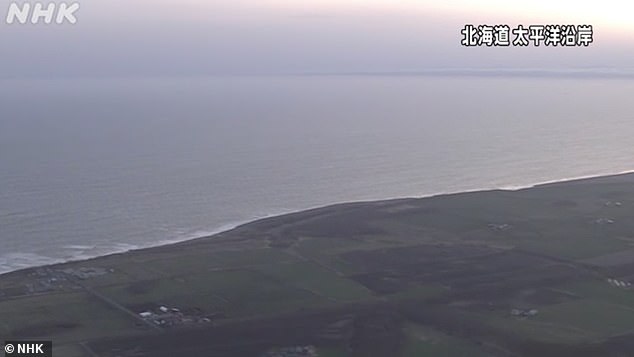
Japan accounts for 18% of the world’s earthquakes (Photo: Japan’s coastline hit by large waves)
The government said the Nankai Trough earthquake and subsequent tsunami could kill up to 298,000 people and cause up to $2 trillion in damage.
The Japan Meteorological Agency lifted the advisory for 2024 a week later, but it led to panic buying of staple foods such as rice and caused vacationers to cancel hotel reservations.
Japan has issued its second week-long “major earthquake” advisory for December 2025 after a magnitude 7.5 tremor occurred off the north coast.
The Dec. 8 earthquake generated a tsunami of up to 28 inches and injured more than 40 people, but no major damage was reported.
#massive #magnitude #earthquake #hit #Japan #warns #strong #shaking #triggers #tsunami #coastal #evacuations