
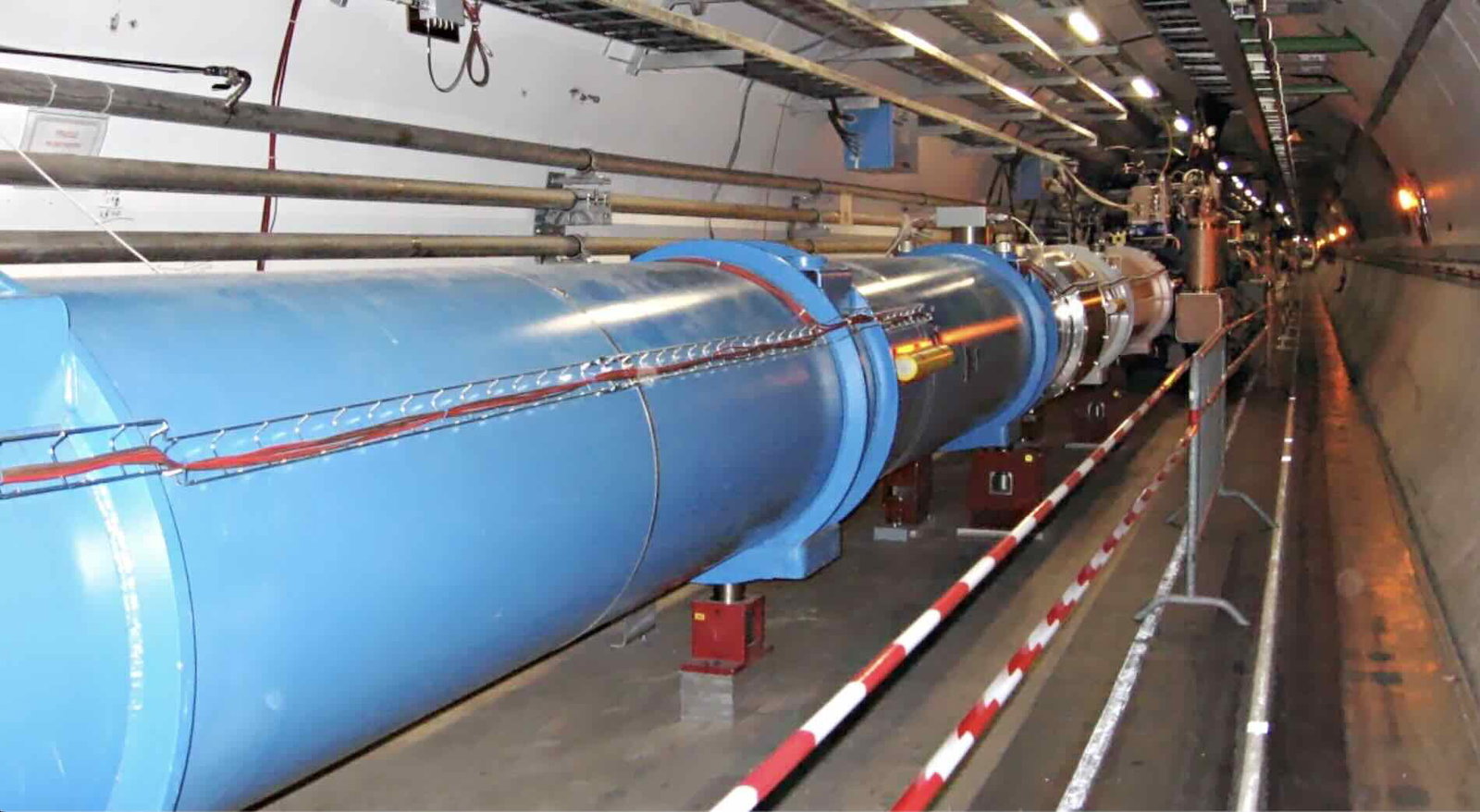
Physicists studying the famous Large Hadron Collider (LHC) at CERN in Geneva, Switzerland, say a recent experiment may reveal undiscovered physics that casts doubt on the Standard Model.
The Standard Model, considered the dominant framework of modern physics for more than half a century, is now faced with intriguing hints from LHC experiments that suggest the behavior of elementary particles may contradict this long-held view of the universe.
The discovery was detailed in a recent article by William Barter, a physicist at the School of Physics and Astronomy at the University of Edinburgh, and Mark Smith, a researcher in collisional physics at the School of Natural Sciences at Imperial College, London. of conversation, This paper details the findings reported in a new paper accepted for publication in 2016. Physical review letter.
If the discovery is verified, it could lead to a further accumulation of data that could help physicists overturn the prevailing models that underlie much of our understanding of the phenomena observed in the universe.
components of the universe
According to the Standard Model, there are four fundamental forces that govern the phenomena observed in the universe: gravity, electromagnetism, the weak force, and the strong force, all of which influence the behavior of particles down to the tiniest building blocks known as elementary particles.
The Standard Model explains a lot about how these forces govern our universe, but there are still missing pieces to this long and mysterious puzzle. According to Barter and Smith, the Standard Model “is our best understanding of fundamental particles and forces, but we know it’s not the whole story.” They, like a growing number of physicists today, argue that the currently widely accepted model cannot explain gravity or dark matter, for example.
Physicists are now using the LHC to crush particles and create conditions not unlike those close to the beginning of the universe as we know it. In doing so, researchers can glimpse undiscovered physics through the creation of unusual states of matter.
Recent results from LHCb, which investigated the decay of subatomic particles called B mesons, appear to disagree with most predictions of the Standard Model.
Such experiments essentially aim to test a theory first proposed by Einstein over a century ago. “Physicists can rigorously test their theories by comparing measurements made at facilities such as the LHC with predictions based on the standard model,” the authors write. conversation.
“Despite the fact that the Standard Model is known to be incomplete, particle physicists have yet to find any cracks in the theory, despite more than 50 years of increasingly rigorous testing,” they claim. But that may be about to change.
Standard model testing
Barter and Smith say there is growing evidence of cracks in the Standard Model, specifically the results of LHC experiments first reported in early 2025.
“Although the CMS results are not as precise as the LHCb results, they are in good agreement and strengthen the case,” Barter and Smith noted, adding that the new results, including so-called “electroweak penguin decay,” point to a specific type of process in which the transformation of short-lived particles occurs. In the case of the recent LHC experiment, the authors say this is the case for the B meson, which decays (or transforms) into four different subatomic particles. These include two muons, a kaon, and a pion.
By measuring the decay of B mesons in this way, physicists can study how particles known as “beauty quarks” transform into another type of fundamental particle: the enigmatic “strange quark.”
As Barter and Smith point out, it is extremely rare in the Standard Model to observe a Penguin decay under these conditions, as only one decay is expected to occur for approximately every million B mesons present. But the team’s recent measurements have revealed the most accurate numbers yet for how often this process is expected to occur, and the numbers simply don’t match those predicted by the standard model.

“The Penguin process has a unique sensitivity to the effects of new, potentially very heavy particles that cannot be produced directly at the LHC,” the authors note, adding that these recent observations come on top of the growing number that has been observed by physicists over the past century, and whose number has increased in recent decades thanks to what can be accomplished using the LHC.
“Our research on rare processes allows us to explore parts of nature that are inaccessible only through particle colliders, which are planned for the 2070s,” Barter and Smith write, noting that such explorations at the cutting edge of physics suggest the need for new theories to help explain the discoveries. Some of these involve the incorporation of various new particles known as “leptoquarks,” while other approaches involve even heavier types of particles that conform to the Standard Model.
Although the discovery is interesting, the researchers stress that, at least for now, there are still questions that prevent us from openly accepting an entirely new physics beyond the Standard Model. Still, they argue that even when combining theoretical models and experimental LHCb data, it is difficult to explain the unusual nature of the findings.
The authors note that nearly 650 billion B meson decays were recorded between 2011 and 2018, revealing the existence of so-called “penguin decay,” but they note that the recent LHCb experiment has already recorded three times that many B mesons, so physicists are hopeful that future discoveries like those reported by Barter and Smith will be confirmed.
In the coming decades, upgrades to the LHC will enable even larger data sets that could ultimately confirm whether unexplained factors are at work in our universe and fundamentally reshape our understanding of the physics behind how things work.
Barter and Smith reported the results of their collaboration behind a recent experiment. conversation, The paper that published the results was Physical review letter.
Micah Hanks is the editor-in-chief and co-founder of The Debrief. He is a longtime science, defense, and technology reporter with a focus on space and astronomy. Contact details are as follows: micah@thedebrief.org. Follow him on X @MicahHanks,and micahhanks.com.
#Large #Hadron #Collider #experiment #suggests #undiscovered #physics #overturn #Standard #Model #physicist