
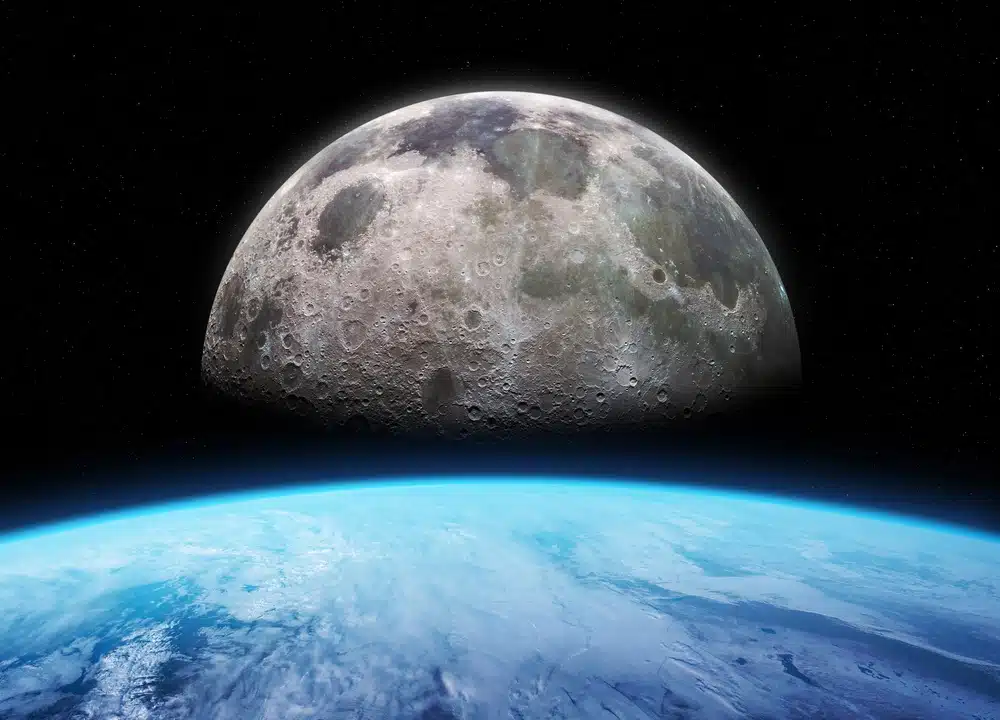
If you clicked on that headline because you wanted to get an extra hour of sleep next Monday, you can relax. of 25 hours a day is approaching, but that date is approximately 200 million years from now. You still have time to adjust your alarm clock.
The real story hidden beneath the viral headlines is more immediate and more disturbing. Since 2000, the familiar 24-hour cycle has grown at the following rate: 1.33 milliseconds/century. The reason has little to do with the moon’s ancient gravitational pull. A new force slowing the Earth’s rotation is the accelerated melting of the Greenland and Antarctic ice sheets.
“In just 100 years, humans have changed the climate system so much that we can now see the effects in the very rotation of the Earth,” said Surendra Adhikari, a geophysicist at NASA’s Jet Propulsion Laboratory and co-author of the recent discovery.
The moon is losing its grip on the clock
For 4.5 billion years, rotation of the earth It has been ruled by a simple gravitational tug of war with the moon. The moon’s gravitational pull causes tidal ridges in the ocean. As the Earth rotates under its bulge, friction with the ocean floor acts like a permanent brake pad. This process robs the planet of its rotational energy, slowing it down by about a factor of 1, according to a detailer at NASA’s Goddard Space Flight Center. 2.4 milliseconds per century.
Its speed is so slow that it takes 200 million years to add one hour to the day. There are no calendar dates to circle. The 25-hour day is not a scheduling conflict, but a geological certainty.
But that age-old, predictable rhythm is breaking down. Researchers led by Mostafa Kiani Shahvandi at ETH Zurich analyzed more than 120 years of data and found that climate-induced mass transfer is currently accelerating the slowdown beyond what can be explained by the moon alone.
The ice melts and the earth becomes flat
Between 2000 and 2018, day length reached 1.33 milliseconds per century, especially due to ice melt and groundwater decline. Over the past 100 years, the same contribution has never exceeded 1.0 milliseconds per century. The full discovery is detailed in a NASA Earth Science report published in July 2024.
Physics is intuitive. When the giant ice sheets of Greenland and Antarctica melt, the water doesn’t stay at the poles. It flows into the equatorial ocean. This redistributes mass toward the center of the Earth, flattening the planet’s shape by a small but measurable amount. A flat sphere rotates more slowly. This principle is similar to how ice skaters extend their arms to slow down their rotation.
The research team made these measurements using satellite data from NASA’s GRACE mission and its successor GRACE-FO. Mass change Exactly. They combined these observations with historical material balance studies to reconstruct trends going back to 1900.

The conclusion is clear. If greenhouse gas emissions continue to increase along their current trajectory, climate-induced day length could reach 2.62 milliseconds per century by 2100. At that point, human-induced ice melting will overtake the Moon’s tidal friction as the primary brake on the planet’s rotation. For the first time in Earth’s history, celestial bodies will no longer be the dominant forces shaping the length of the day. It will be terrestrial.
Why milliseconds matter in modern life
A few thousandths of a second sounds abstract. For GPS satellites, this is a fatal error.
global positioning system It works by measuring the time it takes for a radio signal to travel from a satellite to a receiver on the ground. Light travels about 300 meters in 1 microsecond. If the atomic clock that controls GPS deviates by even a second from Earth’s actual orientation in space, the resulting position error can span a city block.

Organizations such as the International Earth Rotation Reference System Service publish regular bulletins that track the difference between precise atomic time and the planet’s irregular rotation. Since 1972, timekeepers at the National Institute of Standards and Technology have 27 leap second Change to Coordinated Universal Time to keep the two systems in sync. The last leap second was inserted on December 31, 2016.
accelerated melting polar ice It introduces new and unpredictable variables into those calculations. As Adhikari’s team pointed out, the planet’s rotation is no longer a purely astronomical problem. It’s now a climate issue.
The axis wanders accordingly
The same redistribution of mass that slows down rotation also shifts the position of the axis of rotation itself. Scientists call this phenomenon polar motion.
Using machine learning algorithms to analyze 120 years of measurements, the research team found that 90 percent of the repeated variations in axial position can be explained by changes in groundwater, ice sheets, glaciers, and sea levels. Over the past century, the Earth’s axis has shifted about 30 feet.
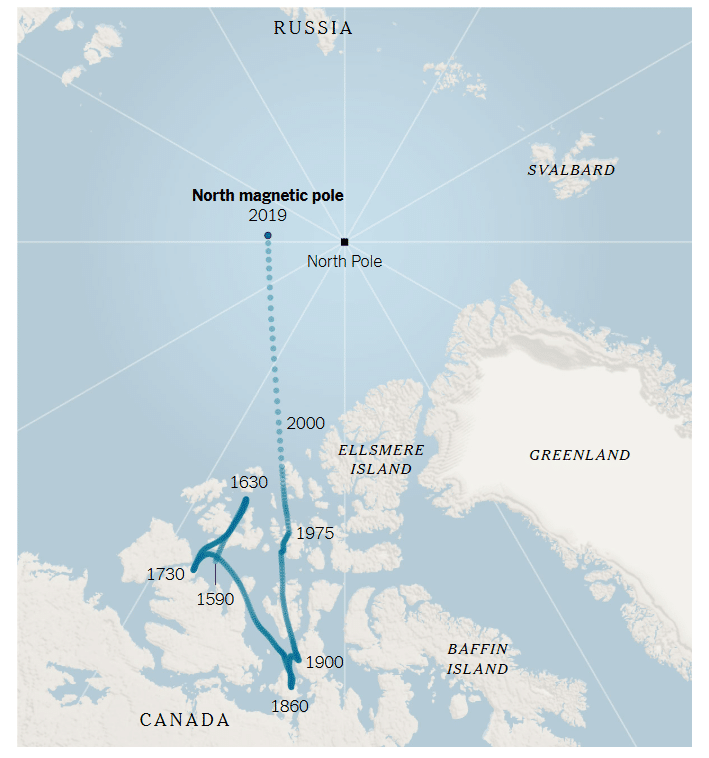
The sudden eastward shift that began around 2000 was found to be a direct result of accelerated melting in Greenland and Antarctica and groundwater depletion in Eurasia. The evidence converges on one point. Climate-induced changes in surface mass are now detectable on a global scale.
24 hours long farewell
A University of Toronto study published in Science Advances provides a useful reminder of just how extraordinary this moment is. The study, led by theoretical astrophysicist Norman Murray, showed that for more than a billion years, the length of the Earth’s day remained constant at 19.5 hours. Ann atmospheric tides Driven by the Sun, it resonated with the planet’s rotation and completely canceled out the Moon’s braking effect. This natural impasse ended long before humans arrived.
The current acceleration is unnatural. This is a direct result of ice loss due to rising global temperatures. of length of the day Eventually, at 25 hours, we’ll arrive at a planet formed by forces we’re just beginning to measure.
To easily compare how day length varies across the solar system, NASA’s Space Place provides a clear breakdown of the planet’s rotation period.
#Goodbye #24hour #days #day #day #Earth #hours