
The world is warming and a new study warns that almost a third of people could face the double whammy of heatwaves and drought five times more often by the 2090s.
Researchers in Germany and China investigated combined hot and dry extremes, where severe droughts and intense heat waves occur simultaneously in the same place.
Based on the researchers’ modeling and current emissions trends, 28 percent of the world’s population, or about 2.6 billion people, will experience conditions that are at least five times more extreme by the end of the century than at the beginning.
When heat and drought are combined, the effects are much more severe than either alone. It comes not only with heat-related deaths, but also with increased risk of wildfires, increased agricultural losses, and higher levels of socio-economic instability.
“Heat and drought amplify each other,” said Di Kai, a climate scientist at Ocean University of China. “Combined high-temperature dryness leads to water restrictions and unstable food prices. For those working outdoors, it’s dangerous.”
The researchers combined data from 152 climate simulations based on eight different climate models used to predict population growth and climate change in the Intergovernmental Panel on Climate Change’s (IPCC) Sixth Assessment Report.
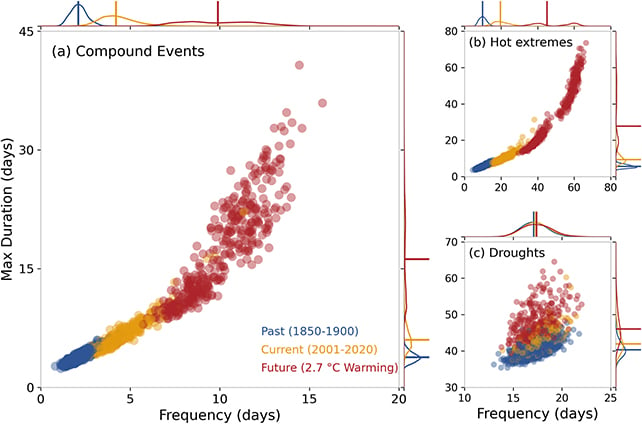
Based on government policies currently in place, data show that by 2100, temperatures will rise by 2.7 °C and levels of combined heat and dryness extremes will increase. These events were defined as temperatures in the top 10% of the region based on historical records and droughts classified as moderate or above.
According to researchers’ modeling, by the end of this century, the entire planet will face 2.4 times as many combined high-temperature and dry events as today, and those events will last up to nearly three times longer than they do now.
However, there will likely be significant differences by region in how this increase is felt. Tropical countries and low-income countries, which contribute the least to global warming, will be hit hardest.
“There is a huge inequity here for low-income countries,” Tsai said. “It’s hard to fund air conditioning. It’s hard to fund health care. There’s no backup when the water runs out. This isn’t just a climate science problem; it’s a basic everyday life problem.”
Model simulations made it very clear that anthropogenic greenhouse gas emissions are the main cause of the continued rise in global temperatures and are already “exaggerating” extreme weather events.
“The choices we make today will directly impact the daily lives of billions of people in the future,” Tsai said.

This study shows there is another way, reaffirming how much of a difference emissions reduction policies can make.
The analysis found that adding new commitments and binding long-term commitments to the 2015 Paris Agreement could reduce the number of people affected by these compound events by a third.
If these commitments were fully implemented, the proportion of the world’s population exposed to extreme heat and dryness would decrease five times from 28 percent to 18 percent, meaning nearly 900 million fewer people would be affected.
RELATED: Penguins may be adapting to a rapidly warming climate, but it comes at a cost
Further analysis could provide more detailed information about the risks, but the researchers said of their study:It shows the urgent need for fair and immediate climate action that protects those most at risk. ”
“If almost 30 percent of the world’s population would be affected by this, it would be very dangerous,” said Monika Ionita, a climatologist at the Alfred Wegener Institute in Germany. “It should make us think much more deeply about our future actions.”
This research Geophysical Research Letters.
#face #times #extreme #heat #droughts #century