
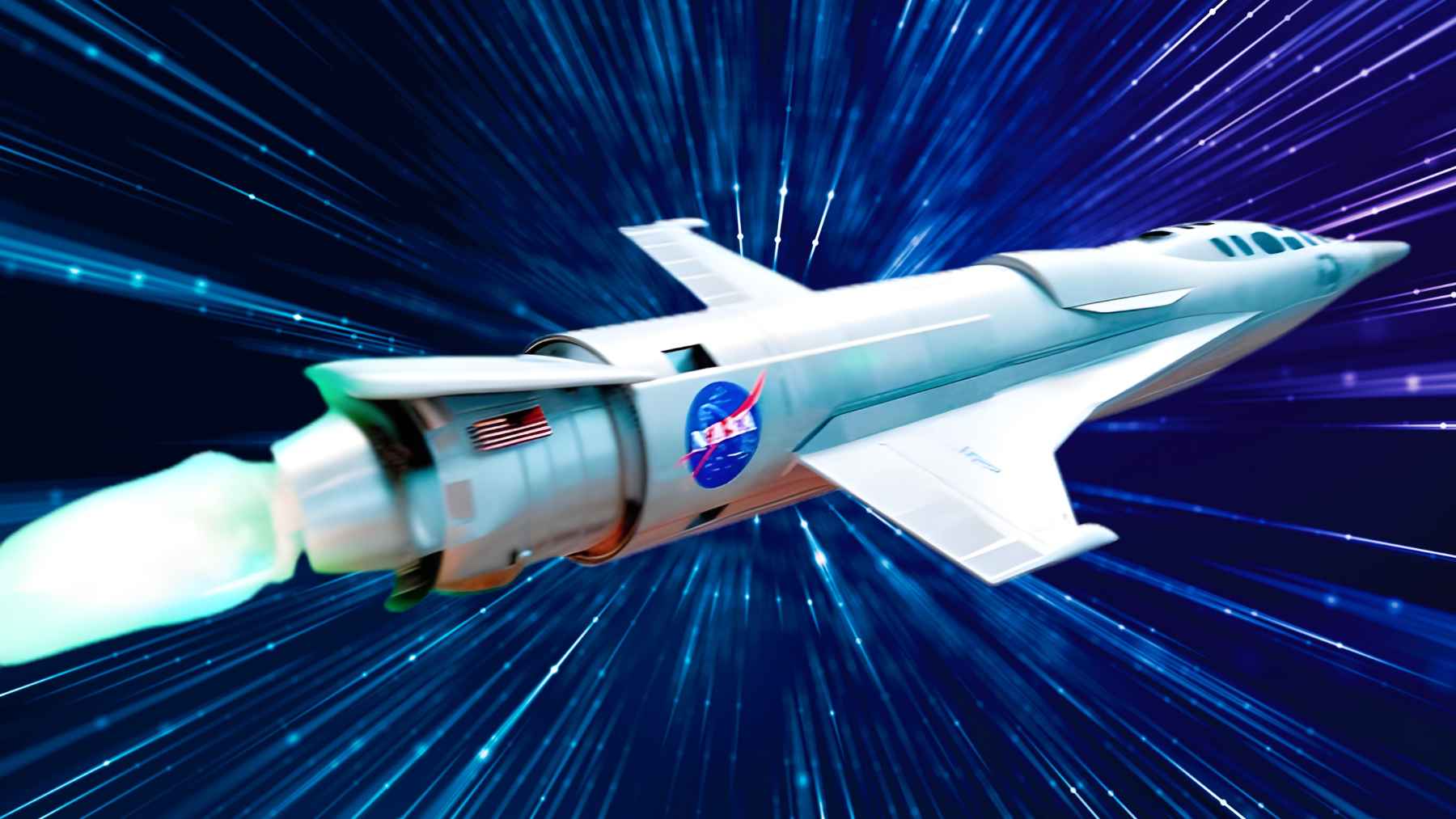
A new scientific paper is adding new fuel to one of space science’s most stubborn fantasies: a “warp drive” that could make distant stars feel like forever away.
The research proposes a new way to create so-called warp bubbles, distorted regions of space-time that carry spacecraft, without the ships themselves breaking the cosmic speed limits.
The problem is the same one that has plagued the warp drive idea for decades. The calculations may be consistent, but the real universe still requires materials we don’t know how to make, especially large amounts of “negative energy.” So is this a real step forward, or just a prettier blueprint for an engine that can’t be built yet?
A new twist on warp bubbles
In a new paper, Harold “Sonny” White, an aerospace engineer at Casimir, and co-authors Jerry Berra, Andre Sylvester, and Leonard Dudzinski laid out what they call a “flat-interior cylindrical nacelle warp bubble.” Simply put, it reshapes the classic warp bubble design, keeping the inside quiet and flat while the outside does the heavy lifting.
The big geometrical change is how the exotic energies are arranged. Rather than extending smoothly around the aircraft in a single donut-like ring, this model breaks it up into separate tubular segments, much like engine pods mounted around the fuselage. The team will analyze versions that use two, three, or four of these segments spaced around the bubble.
The design also invites obvious pop culture comparisons, which the lead author leans into. he said. Debriefing session“The similarities with the USS Enterprise’s twin nacelles are more than just aesthetic.” It’s a fun line, but it’s also a clue to what this paper is really trying to do: make warp math look like something engineers could someday test.
How warp drive avoids the speed of light limit
When people hear “faster than light,” they usually imagine a ship hurtling forward like a rocket, but it’s just faster. That doesn’t happen in modern physics. This is because bringing an object with mass closer to the speed of light requires more and more energy, and the demand does not level off.
The warp drive concept tries to get around this problem by changing the road instead of pressing down on the gas pedal. The core idea is that by compressing the space in front of the ship and expanding the space behind it, the bubble moves even though the ship inside the ship is not locally exceeding the speed of light.
Its basic blueprint dates back to a 1994 proposal often referred to as the Warp Drive Metrics Paper.
In everyday terms, it’s like being transported on a moving walkway at an airport. You’re not sprinting faster than everyone else, but you still get to the gate early because the sidewalk is doing its work beneath you. The difficulty is that in physics, “building a passageway” means reshaping space-time itself.
Keeping astronauts safe inside the bubble
One reason the new paper has attracted attention is its focus on livability, not just geometry.
Much of the warp drive debate is bogged down in how to move the bubble, but manned missions also need an interior area where the crew won’t be crushed by extreme gravitational stretches. These “tidal forces” are the same basic effects that cause ocean tides on Earth, just scaled up to be much more dangerous.
The authors emphasize the condition of “flat interior.” This means that even though the outer shell is highly distorted, the cabin region is a mathematically flat space-time. They use the standard relativity approach of dividing spacetime into time slices, allowing them to track how the bubble evolves and how the forces are distributed around it.
There are also practical reasons to value a stable interior. If clocks and physics continue to work properly inside the bubble, there will be one less layer of disruption to future navigation and life support systems. This is still just a theory, but it aims to be a question that engineers actually have to answer.
negative energy problem
This is where the sci-fi vibe hits a wall. Most warp drive solutions require “negative energy.” This is a type of energy density below the vacuum level and is sometimes described as requiring “exotic matter.” Physics allows for small negative energy effects in very specific quantum settings, but scaling them up to the size of a spacecraft is another world of difficulties.
This is not just a hand-waving complaint. A widely cited review, a 1997 analysis by Michael J. Fenning and L.H. Ford, applies quantum limits to warp bubbles and concludes that negative energy must be squeezed into an absurdly thin shell and that the total energy demand is physically unattainable.
In other words, even if the math works, known physics will violently push back.
There is also the question of whether the universe provides us with negative mass and negative energy in a usable form. Abi Loeb, an astrophysicist at Harvard University, has argued that the vacuum energy inferred from the expansion of the universe is so dilute that even if you harvested it from a cube 19 miles on a side, you wouldn’t be able to power a 100-watt light bulb for one minute.
He also writes that “as far as we know, there is no physics that gives rise to objects of negative mass.”
Steering operation and risk of collision
Even if someone solved the energy problem tomorrow, they would still need to start a warp bubble, maneuver it, and shut it down safely.
A subsequent technical review noted that at superluminal speeds, observers on board the ship may face a “horizon problem” and the crew may not be able to generate or control bubbles on demand from within the ship. This is a subtle point, but it’s important because you can’t fly something you can’t control.
Then there’s the question of what the bubble does to everything in its path. A 2012 study investigated the interaction between particles and Alcubierre-type bubbles and suggested that some particles may become trapped and deposited, releasing powerful energy as the bubble decelerates near its destination. It’s like the risk of turning a clever shortcut into a cosmic snowplow.
It’s also worth remembering that today’s propulsion power falls short of even light flight. Loeb points out that our rockets don’t travel faster than about 0.01% of the speed of light, which could help explain why our closest stars travel thousands of years using current methods. There is still a huge gap between “cool equations” and “safe transportation.”
What comes next for warp drive research?
The more practical short-term value of such a paper may be to turn the warp drive story into a testable question. How do we detect small, artificially created distortions of space and time in the laboratory, even on a microscopic scale? What measurements count as real evidence rather than noise? These are the kinds of steps that distinguish speculation from research programs.
At least on paper, there are parallel efforts to avoid negative energy altogether. For example, Eric Lentz has proposed soliton-type warp solutions aimed at harnessing positive energy, and other researchers are planning “physical warp drives” focused on slower-than-light bubbles as a more plausible starting point.
None of these approaches are close to hardware, but they do show that there is a lively debate about what general relativity allows, and what nature actually allows.
So when do these things matter for real-world travel? No one can give a timeline with confidence, and that uncertainty is part of the story.
In a separate conversation about how fundamental physics is turning into useful technology, researcher Sabine Hossenfelder noted that it could be “maybe 1,000 or 5,000 years” before today’s abstract ideas become practical tools. When it comes to warp drive, such a long period of time may be the most honest answer at the moment.
The main research is classical gravity and quantum gravity.
#Scientists #theyve #discovered #travel #speed #light #detail #dampens #excitement #means #humans #wait #years #test