
Exploding stars, black holes, and forbidden crevices
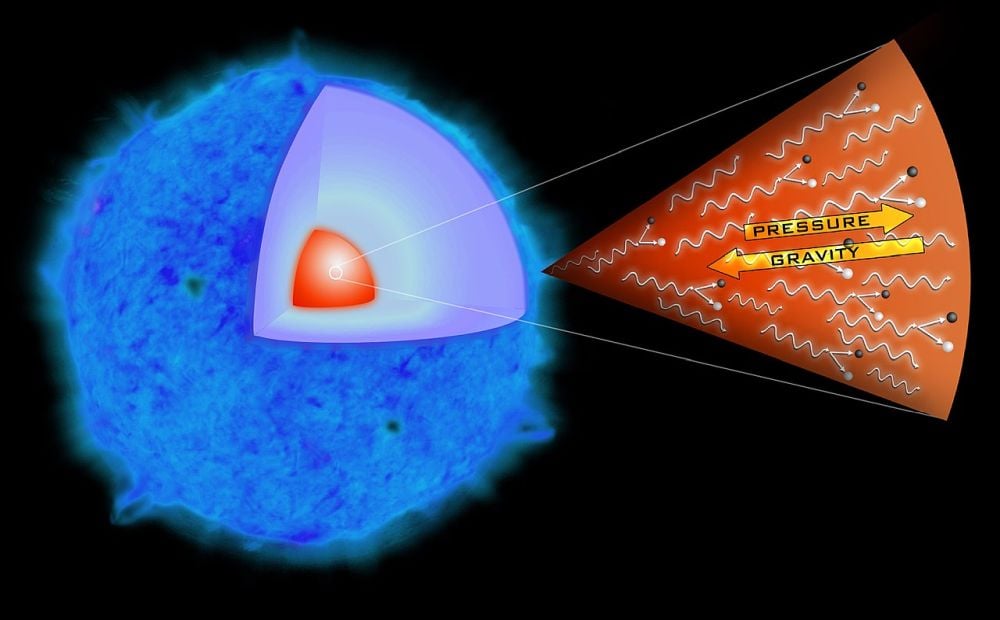
This image shows what's happening inside an unstable supernova. In very massive stars, the gamma rays produced at their centers can be so energetic that some of that energy escapes, producing electron-positron pairs. This reduces the star's radiation pressure, causing it to partially collapse under its own powerful gravity. After collapse, a runaway thermonuclear reaction (not shown here) occurs and the star explodes. Nothing is left behind, not even a black hole. Image credit: From NASA/CXC/M. Weiss - http://chandra.harvard.edu/photo/2007/sn2006gy/more.html, especially http://chandra.harvard.edu/photo/2007/sn2006gy/sn2006gy_ill.tif, public domain, https://commons.wikimedia.org/w/index.php?curid=2082949

When the first gravitational waves (GW) were detected in 2015, scientists said they had opened a new window into the universe. Most of astronomy is based on detecting electromagnetic energy, but GW is different. They are ripples in spacetime predicted by Einstein. Using GW detectors, it is now possible to detect mergers between black holes … Read more